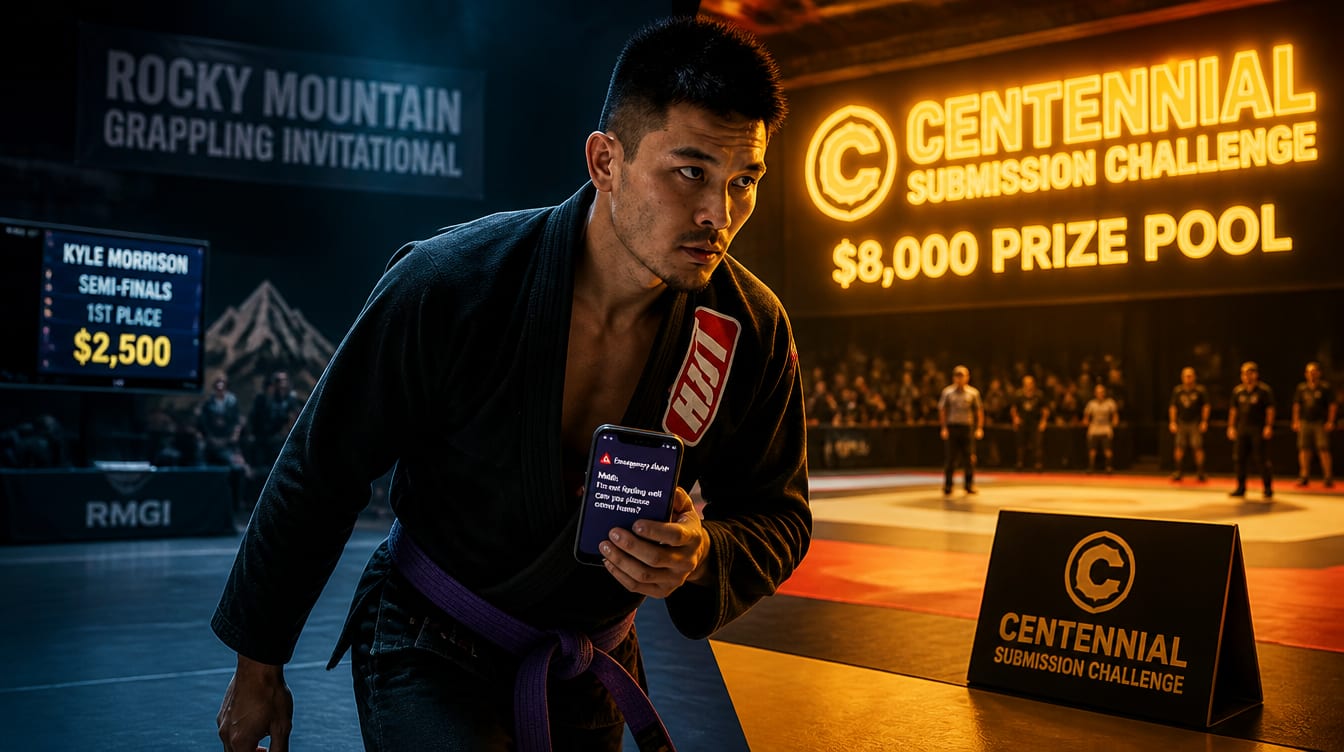
Kyle Morrison, a 28-year-old purple belt from Littleton, Colorado, withdrew from the Rocky Mountain Grappling Invitational on Thursday morning, citing an “unexpected family medical emergency” that required his immediate attention. The tournament, held Saturday in Denver, offered a first-place purse of $2,500. Six hours before his scheduled semi-final match, Morrison’s gym owner Trevor Chen received the withdrawal notice via email. But at 6:47 PM Saturday—right when his semi-final would’ve started, 90 minutes north—Morrison was spotted on video grappling in the finals of the Centennial Submission Challenge, held in Colorado Springs. The Centennial’s first-place purse was $8,000.
The withdrawal itself had seemed routine at first. Morrison had qualified through the regional trials three weeks prior, was seeded second in his weight class, and had been texting his training partner Marcus Webb about his game plan throughout the week. “He was drilling butterfly guard passes on Wednesday like his entire family’s survival depended on it,” Webb recalled. “Thursday morning—suddenly his grandmother needs emergency back surgery. But here’s the thing: his grandmother lives in Tucson. She doesn’t live here. Never has.”
Chen, a fifteen-year veteran gym owner who respected athletes’ circumstances, honored the withdrawal without pushback. “Family comes first. That’s what we tell people,” Chen said. But skepticism crept in six hours later when Morrison’s wife Sarah posted an Instagram story from the Centennial venue: a photo of Kyle mid-roll against an opponent, tagged with the federation name, the venue location, and the caption “Taking down the old competition.” She added three grappling hashtags and a laughing-crying emoji. No mention of surgery.
Morrison didn’t just show up at the Centennial event. He competed with what observers described as “unusual intensity.” His semi-final match against Andre Simmons, a local competitor with a reputation for strong wrestling, drew ringside comments about Morrison’s energy level. “I’ve never seen Kyle pass guard that urgently,” one spectator noted in the match chat. “It’s like someone was paying him double money.” Morrison advanced to the finals, finished third overall, and collected $3,200, a $700 gain over what he’d have earned at Rocky Mountain, even with a first-place finish.

When reached for comment via text message, Morrison claimed the withdrawal had been sent “as a precaution.” He explained that his grandmother’s surgery had been “scheduled tentatively” but was pushed to Monday morning. When asked why he hadn’t notified Rocky Mountain that the emergency had been downgraded, Morrison didn’t respond. When asked why his wife had posted the video, he wrote: “She wasn’t thinking about optics.”
Trevor Chen found himself in a professional bind. He’d endorsed Morrison’s withdrawal to the Rocky Mountain organizers, a gym owner named Derek Paulson who Chen collaborated with on a referral program. Chen also had athletes competing at Rocky Mountain, and now had to explain why his guy suddenly recovered. “Kyle’s a good person. Genuinely. But this creates a problem,” Chen said in a follow-up conversation. “If everyone starts gaming the system like this, we lose the integrity of the entire regional circuit. Other gym owners start wondering if my withdrawals are legitimate. It spreads.”
The real escalation happened on the Centennial Submission Challenge’s official Discord server, where spectators had archived video timestamps. One user with the handle @grapplefacts posted a detailed timeline: Morrison’s withdrawal email (Thursday 8:14 AM), his wife’s Instagram post from the Centennial venue (Saturday 6:47 PM), match footage from his semi-final (7:15 PM), and his third-place finish photo (8:04 PM). The Discord descended into a twenty-four-hour argument about athlete ethics, withdrawal transparency, and whether Morrison owed anyone an explanation.
Janet Reeves, the Centennial federation director, acknowledged the optics problem: “We don’t regulate where athletes compete. But when someone withdraws from a tournament citing an emergency and then competes 90 minutes away the same day, it sends a message about their priorities. And it makes every other withdrawal harder to believe.” Reeves paused. “Especially when it’s the purse difference.”
Morrison turned out to be part of a pattern. A quick search of regional tournament records from the past six weeks found at least four other athletes who had cited personal conflicts at lower-purse events, then appeared at higher-purse tournaments within twenty-four hours. One wrestler named James Hartley withdrew from the Fall Open in Kansas City ($2,000 purse) claiming “unexpected work obligations,” then competed at the Midwest Submission Cup forty miles away the following afternoon ($5,000 purse). When asked about the rapid resolution, Hartley said the work situation “resolved faster than anticipated.”

Marcus Webb, Morrison’s training partner, said the situation had shifted his thinking about the whole withdrawal culture. “We’ve always assumed people are honest. But now every withdrawal email gets a little sidebar conversation. Did he actually have an emergency, or did he just find a better tournament?” Webb said. “It poisons the thing.”
Chen has since implemented a new policy at his gym: all withdrawals now require seventy-two-hour notice and a brief written explanation, including whether the athlete plans to compete at another event within a week. “I’m not trying to be a detective,” Chen said. “But if someone’s grandmother really is having emergency back surgery, she probably shouldn’t get bumped to Monday morning the same moment a better purse opens up at another tournament.”
Morrison has made no additional statements. But Sarah posted another Instagram story on Wednesday morning: a photo of Kyle rolling during technique work, captioned with “#SupportSystemFamily #WholeHealthWellness #FamilyFirst.” The timestamp suggested she’d taken it before dawn. No mention of his grandmother’s surgery status.
The Rocky Mountain organizers refunded Morrison’s entry fee and moved his seed position to an alternate. They’ve since added a note to their withdrawal policy: athletes who withdraw and then compete at another IBJJF-sanctioned event within forty-eight hours will be flagged for the following season’s seeding consideration. But the Centennial Submission Challenge Discord will remember. They always do.