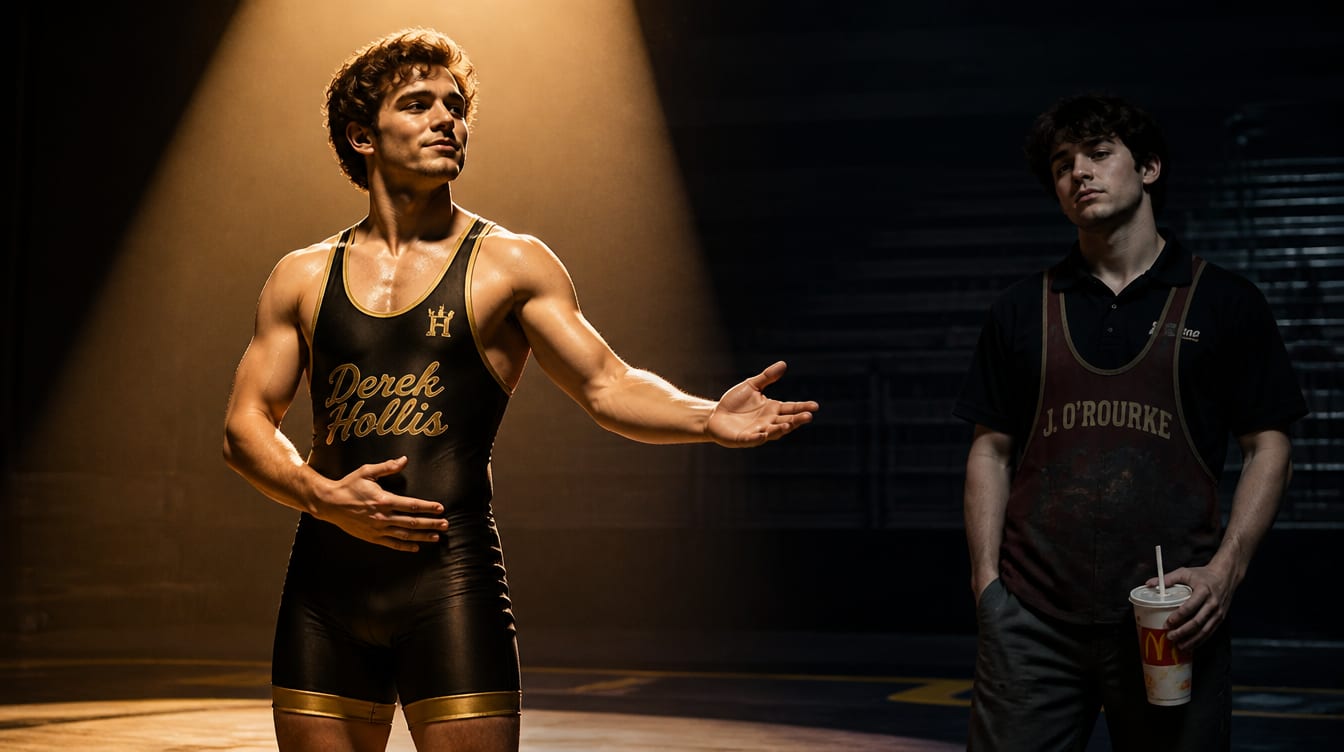
Derek Hollis, a 27-year-old wrestling coach from Columbus, Ohio, with 243,000 TikTok followers, a custom singlet embroidered with his name in metallic gold lettering, and a contractual obligation to post daily training content until September 1, lost the Midwest Wrestling Collective championship on August 23 to a 21-year-old named Ethan Mackey, who had never competed above the regional high school level, does not maintain any social media accounts, and drove four hours to the venue from Akron because his mother had offered to buy him lunch afterward.
The match lasted six minutes and forty-three seconds. Hollis had spent eight weeks preparing. Hollis’s training regimen, titled “47-Part Deep Dive Into Advanced Double-Leg Combinations,” had racked up 890,000 views across platforms and included sponsored content for a pre-workout supplement called Dominance Fuel ($34.99 per canister, three-canister monthly minimum, affiliate commission 8%).
He’d hired three assistant coaches, all of whom wore color-coordinated wrist wraps during filming and maintained spreadsheets tracking his flexibility, heart rate variability, and psychological readiness scores. He posted daily Instagram Stories—“The mind is the real opponent,” “Sleep is a weapon,” “They’re not ready for this”—none of which were directed at anyone in particular, because Mackey didn’t own an Instagram account and wouldn’t have understood the stakes anyway. Mackey had stopped at a McDonald’s on the drive.
He arrived at weigh-ins at 9:47 p.m., still wearing his AutoZone polo shirt under his competition singlet because he hadn’t had time to change. He’d grabbed his singlet at a thrift shop in Medina for $6.99, and it had a large stain on the right shoulder from an unknown incident and bore the faded name of a previous owner: “Randy—1994.” Mackey thought it was funny.
He had not hired any coaches. When the tournament coordinator asked if he had cornermen, Mackey said, “Yeah, probably should find someone.” His mother had already left to pick up his sister from volleyball, so Mackey’s corner ended up being a random parent named Phil, who offered wrestling advice that was technically sound but delivered at excessive volume: “Stay low, that’s the whole thing!
LOW! Your hips, Derek—wait, your name is Ethan—STAY LOW ANYWAY!” Marcus Webb, Hollis’s lead assistant coach, described the pre-match strategy in an interview conducted three days after the loss, from a coffee shop in Westerville where he sat very still and spoke barely above a whisper.
“Derek’s conditioning was perfect,” Webb said.
“His footwork was textbook. His mental preparation regimen was solid—we did the whole thing, the breathing exercises, the positive affirmations, the playlist with exactly fourteen songs timed to hit peaks during the match. We believed in him completely.
Absolutely completely.” Webb stared into his coffee.
“Mackey just… he kept moving sideways. Like, aggressively sideways. Left, right, left, right.
It was almost disorienting to watch. Derek got frustrated. He lunged.
He got caught in a bad position. It was over.” The match footage, posted by the MWC on YouTube at 11:34 p.m., shows Hollis executing textbook double-legs for three minutes and forty-five seconds.
It shows him landing perfectly timed takedowns, controlling position with precision, and maintaining dominant body language throughout. It also shows, unmistakably, that none of this matters once Mackey starts moving like a person trying to avoid stepping on a snail while crossing a parking lot. Hollis, trained for explosive controlled wrestling, was defeated by someone trained in nothing specific by anyone in particular.
Mackey, when interviewed post-match, was holding a bottle of water from the concession stand (not the premium $6 alkaline water Hollis’s coaching staff had brought) and seemed slightly confused about why anyone cared.
“I remembered wrestling this big guy like two years ago at a regional tournament up in Cleveland,” Mackey explained.
“He liked to lean. I figured maybe this guy was the same. So I kept circling.
Kept him guessing. After like six minutes, he got frustrated and tried a takedown from a bad angle. I countered it.
Got the points.” He paused.
“Hollis seems like a nice guy. His TikTok thing is cool, I guess. I don’t really use TikTok, so I’m not sure what he posted.”
James Ortega, director of the Midwest Wrestling Collective, released a formal statement on August 24.
“The championship was contested according to established rules,” it read.
“Both competitors were notified of those rules in advance. The competitor who followed those rules and executed more effectively won. This is how wrestling works.
We will hold next year’s championship in the same location.” Hollis’s team immediately proposed a best-of-three format for the rematch, scheduled for September, as well as several rule amendments including restrictions on “excessive lateral movement” and a mandatory 15-minute opponent-study period before round two. Ortega declined all proposals.
“The rules existed when he registered,” Ortega said. When asked if he understood why Hollis’s staff felt these changes were necessary, Ortega stared at the questioner for several seconds and said, “No. I genuinely do not.” Within twelve hours, Hollis’s TikTok following had dropped from 243,000 to 238,000.
The “47-Part Deep Dive” series had been viewed zero additional times since the loss. The comments section, previously filled with fire emojis and “GOAT” declarations, had pivoted entirely to variations of the same question: “Was he actually good?” His sponsorship deal with Dominance Fuel was placed “under review by the marketing team,” according to an email sent from a no-reply account.
The affiliate commission structure, pending “strategic reevaluation.” Three regional wrestling publications ran think-pieces on what had gone wrong. One concluded that Hollis had over-prepared.
Another concluded that he had under-prepared. A third concluded that preparation was irrelevant in the face of “raw, undirected chaos,” which seemed to miss the point but generated clicks. Hollis released a statement on August 26.
“I am grateful for the opportunity to compete,” it read.
“I wrestled well. My preparation was thorough and my coaching staff was elite. On this particular day, my opponent executed his gameplan with more efficiency than I executed mine.
I view this as a learning opportunity. I will be returning to competition on a schedule to be determined, and I am already beginning work on a new content series titled ‘What Went Wrong: A Technical Analysis,’ premiering in September.” Mackey, meanwhile, had returned to Akron and his AutoZone job.
When asked by a coworker whether he planned to pursue wrestling full-time, he said, “Nah, man. My manager offered me assistant supervisor. That’s like a buck-fifty raise.
Plus benefits start earlier. That’s the move.” He hasn’t posted anything on social media, doesn’t plan to, and when three separate people tried to call the AutoZone location asking to speak with “that wrestling guy,” he told them they had the wrong number and took their information to delete from the call logs later.
His singlet, the one with “Randy—1994” embroidered on the back, is currently in a hamper in his apartment, waiting to be washed before being returned to the Medina thrift shop. Derek Hollis never competed again.