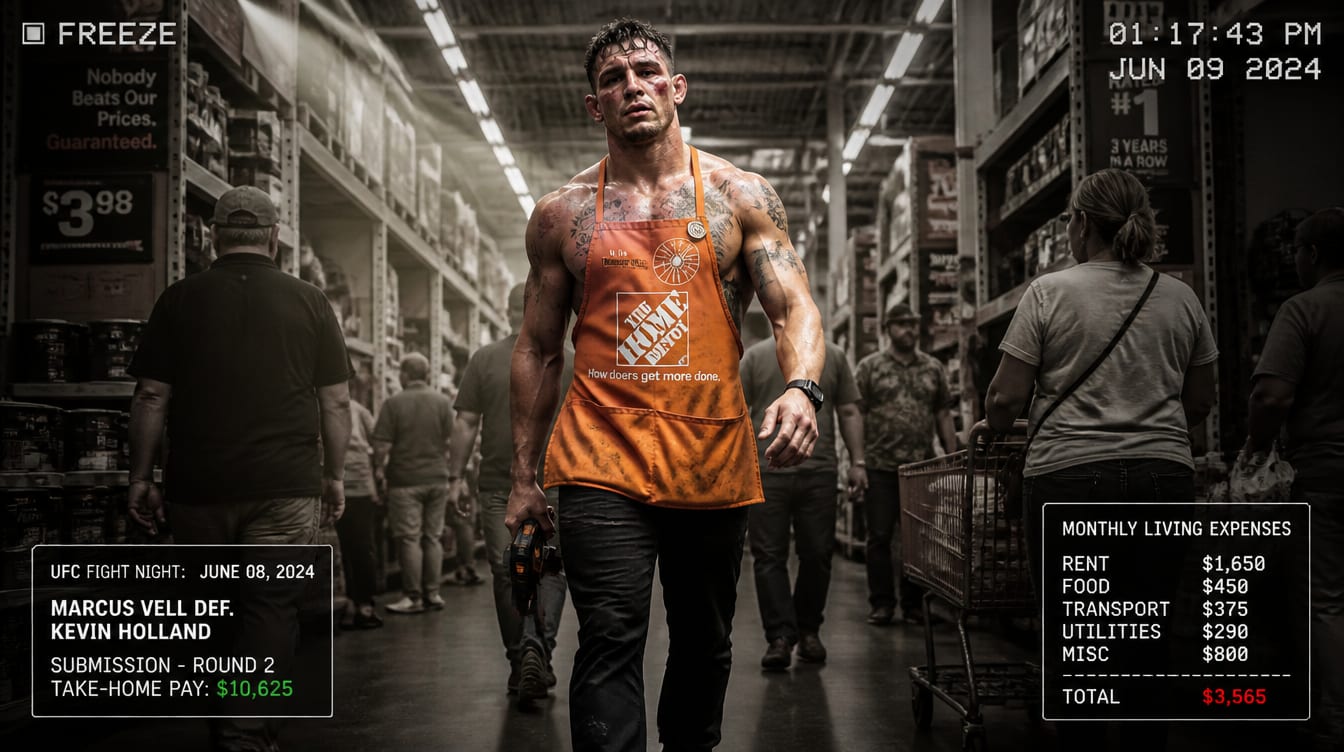
Marcus Vell, 28, of North Las Vegas, Nevada, won his UFC debut on August 24. Second-round guillotine choke at 4:17 against Trey Fitzpatrick at UFC Shanghai. His purse: $12,500. By August 25 at 9 a.m., Vell was back at his register at the North Towne Home Depot location on Boulder Highway, apologizing to customers for his hoarse voice and dutifully clocking in for an afternoon shift that would run until 6 p.m. After federal taxes, state taxes, and his manager’s percentage cut (15%), Vell was left with $10,625. His apartment rent in Las Vegas runs $1,200 per month. His truck payment is $385. Car insurance costs $180 monthly. Gym dues ran $320: one facility for grappling, one for strength work. Groceries and nutritional supplements, a non-negotiable expense for someone training for professional combat, run roughly $400 a month. Utilities, internet, and phone service consume another $280. His pet iguana’s veterinary fund, established after he lost his previous reptile to a respiratory infection, gets $100 a month. His individual health insurance through the ACA marketplace, which he maintains “just in case the fighting thing doesn’t work out,” runs $220 monthly. After accounting for every line item, Vell had $7,895 remaining. September rent was due in three days.
“I told him the economics don’t work until he lands a six-figure contract or secures real sponsorship deals that cover his living expenses,” said Derek Cowan, Vell’s strength coach and owner of Iron Fortress Athletic in Henderson, speaking in his office between client sessions. “He listened, nodded, then asked if we could move his Friday training session to Monday because he’d picked up a full weekend shift at Home Depot. I didn’t ask why. I already knew why.”
The UFC Shanghai contract included no win bonus. Vell had overlooked that detail when reviewing the paperwork before the trip. His promotion deal, signed eighteen months ago when the UFC was still evaluating him against other developing lightweights, guaranteed only $12,500. No bonuses for a win. The UFC organization covered travel ($800), hotel accommodations ($400), and a standardized $80-per-day meal stipend for fight week. After deducting these expenses and his management cut, Vell netted around $10,425 from his first professional victory. His informal financial advisor, Coach Ray, an older fighter at his grappling gym who’d competed in ADCC and Submission Underground, had suggested an aggressive strategy: pocket his first three UFC paychecks without spending them, then “transition out of retail entirely.” Vell was two victories away from that milestone.

Home Depot store manager Patricia Oliveira received his request with bureaucratic politeness. “Good to have you back. We’re conducting a franchise-wide inventory event this weekend,” she said, scrolling through the digital schedule on her iPad while Vell stood in her office. She’d learned about his UFC appearance from an Instagram story his sister had posted—the typical documentation of a family member’s achievement, now complicating payroll logistics. No special accommodation. No reduced hours. Just the full inventory assignment for Saturday and Sunday, the exact days Vell had requested off two weeks ago, before he knew about the UFC Shanghai date.
When Vell delicately asked if the inventory timing could shift by a single day, Oliveira replied with rehearsed corporate language: “It’s a franchise-wide directive. Every store manager is committed to execution,” then pulled up his performance metrics. His customer service speed had dropped 23 percent compared to the previous month. She attributed this to “training, I assume.”
“He’s genuinely a solid employee,” Oliveira told her district manager later, reviewing Vell’s file. “Shows up on time, never complains, calls in absurdly early if he can’t make a shift. But his productivity numbers have declined. Look—I’m not going to tell him he can’t pursue his athletic goals. I get it. But we also operate a business with labor demands. He’s the only person in the entire store who will reliably cover the Saturday 10-to-6 register shift without requesting modifications. That’s become valuable to my operations.” She paused. “I know nothing about fighting or the UFC or why anyone would do that to their body. For my purposes, it’s simply: we need this location staffed, and he fills a scheduling gap that otherwise costs me money.”

Vell’s grappling training partner Xavier, a purple belt with a stable accounting job, offered to loan him $2,000 after hearing about the math. Vell refused immediately, sitting on the mat after class. “I don’t want to start my fighting career already in debt to my training partner,” he said quietly. “That’s a weird dynamic. Plus if it doesn’t work out, now Xavier’s out money and I’m that guy.” He showed up to Home Depot the next morning at 6 a.m., still sore from the guillotine choke, and restocked shelves in the plumbing aisle.
By mid-September, Vell had already negotiated his second UFC bout, booked for November in Mexico City. The purse increased to $13,500, slightly higher thanks to his improved ranking and the org’s ability to pay better when hosting events in cheaper regions. His manager, seeing the upgrade, suggested he push for a win bonus this time. Vell pulled up his calendar and checked it against the Home Depot schedule. The Mexico City event landed on the same weekend as Black Friday inventory. The most labor-intensive retail weekend of the entire year. He texted Oliveira: “Hey Patricia, any chance I could pick up the morning shift on Friday the 29th instead of the full weekend?” Her response arrived thirty seconds later: “Can’t promise it. We’ll see when the schedule opens up.” Vell clocked out early, drove to his second gym for strength training, and began the eleven-week preparation cycle for a fight he couldn’t afford to lose, at a job he couldn’t afford to quit.