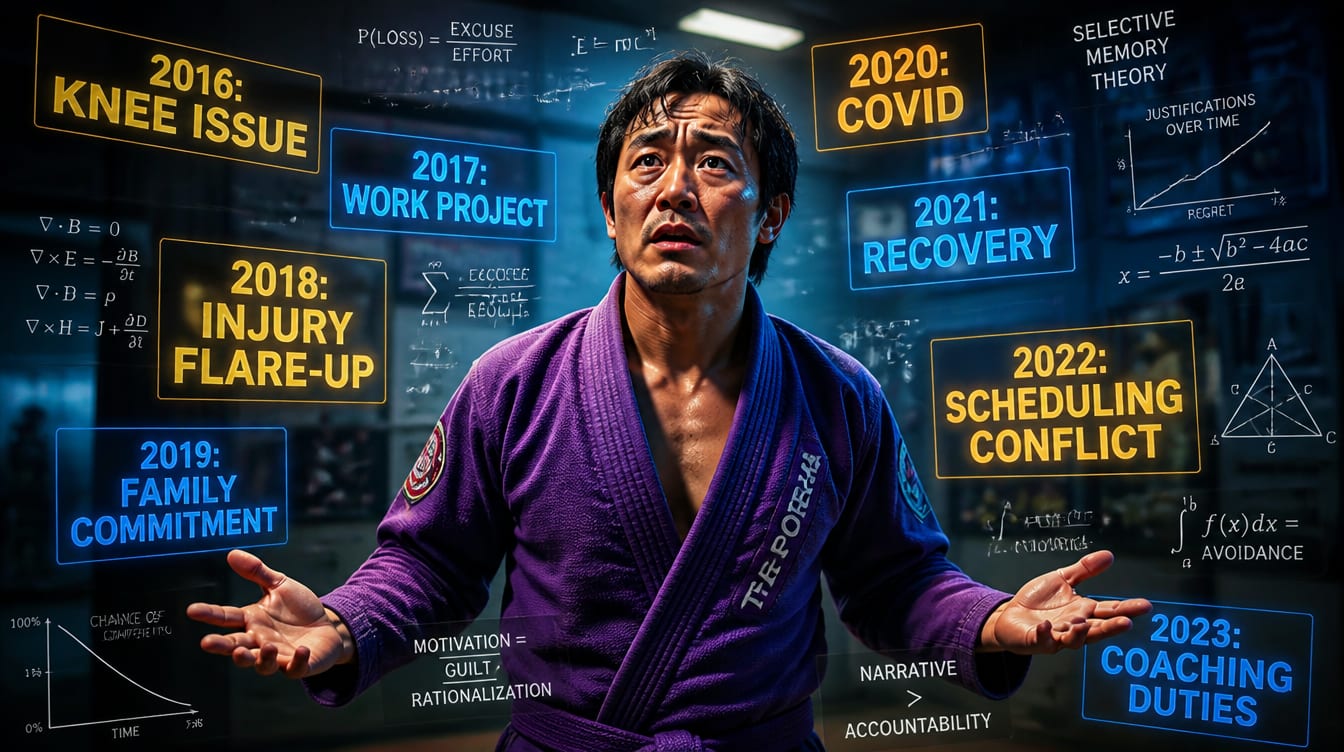
Raymond Park, 34, trains purple belt at Elevation Jiu-Jitsu in suburban Denver. For eight years, he’s maintained his approach is singularly focused on competition prep. He calls it “competition-minded,” “combat-tested,” and “built entirely around tournament performance.” His training partners nod politely. His coaches have stopped asking when he’s competing. His parents stopped asking in 2019.
Park competed once, in 2015. He entered the 170-pound advanced at the Front Range Grappling Challenge in Fort Collins—34 people in his bracket. Lost in the quarters 8-6 to a wrestler named Derek Kowalski. Two arm drags, then Kowalski controlled position the rest of the match.
Park blames the ref. He’s watched the footage 104 times—grainy phone video, 30 seconds of audio. Slowed it down frame-by-frame at 0.25x. Studied still images of the ref’s positioning when the second arm drag went down. The ref, he says, didn’t have a clear line on the contact point. The loss was a reffing mistake.
Since then, he’s turned down 16 tournaments. Eight years of reasons, each one airtight:
2016: Knee issue (minor tweak during training, fully resolved by July, cited as reason through December).
2017: Work project (six-week consulting commitment, March-May; he attended training 4x/week throughout).
2018-2019: Not enough time to train (the gym expanded its evening classes; his attendance remained constant).
2020-2021: “Wrong timing” (no details; plenty of other excuses were available; he picked this one).
2022: Family stuff (he was available for three of five weekends; he selected none).

2023-2024: “Not peaked” (no signs of peaking, no timeline for when he will).
2025-2026: “The field is different now” (true; also irrelevant to competing itself). “Raymond’s definitely competition-focused,” said Marcus Chen, owner and black belt at Elevation, using the careful tone of a man who’d had this conversation six times. “In philosophy, absolutely. In execution, I mean—in terms of his mindset.” Chen paused. “If you asked him today, he’d tell you he’s searching for the right event. He’s always searching for the right event. Very active search.”
The right event must hit several criteria: a division size that reflects his skill level (not too small, suggesting weak competition; not too large, suggesting elite competition requiring an extra training block). Refs he’s researched and approved. A weight class where he fits (fluctuating 167-178 depending on which tournament he’s analyzing). A venue that doesn’t mess with his work-from-home schedule. And a training block to finish first—which always seems to recede another month.
In May this year, Park registered for the Grappling Industries Denver Open. Three weeks away. Fifteen minutes from his gym. 47 people in 170 advanced—he’d called that “optimal.” He paid the $85 entry fee. Drilled four times that week, two rolls against teammates with Kowalski’s arm-drag game. Ordered a new gi.
Friday night before the tournament, 11:47 p.m., he withdrew. Reason: “coaching conflict.” His coach, Marcus Chen, wasn’t consulted. When asked about it, Chen looked confused. Not mad. Just confused. Like reality didn’t match what he knew.
“He told me it would interfere with a training block,” Chen said. “A training block he needed to complete before he’d be ready for a tournament. I asked him when he’d be ready. He said, ‘After the next block. Probably late summer.’” It is now late summer.
Sarah Villanueva, fellow purple at Elevation, trained with Park since 2015. Different take:
“Raymond has achieved something actually impressive,” Villanueva said. “Most people who say they want to compete eventually do it, or they quit the gym, or they accept that they won’t. Raymond’s found a fourth option: infinite preparation. He’s built a system where the act of training has become a perfect substitute for the outcome of competing. He gets all the identity benefits—‘I’m competition-focused,’ ‘I’m tournament-driven’—without any of the actual results.”
Park spends about 2.5 hours a week reviewing tournament brackets. Logs in, writes down names of competitors he doesn’t know. Google-searches their records. Cross-checks them against FloGrappling videos. Notes the refs assigned and watches their patterns. Built seven spreadsheets since 2023. Each has columns: Event Name, Date, Location, Division Size, Refs, Registered Competitors, Travel Distance, Entry Fee, Venue, and Assessment (whether it hits “appropriate calibration”). No tournament has received a final assessment of “enter.”
When asked why he studies tournaments he never enters, Park spoke carefully—as if explaining something obvious to someone who didn’t get it.

“I’m studying the field,” he said. “You have to know the ecosystem before you enter it. I’m building strategic intelligence. Making informed decisions.”
“But you don’t enter,” Villanueva noted.
“Exactly,” Park said, as if this confirmed his point. “I’m extremely selective. That’s called being strategic.”
His latest search started Tuesday, July 22. Opened the Grappling Industries July calendar, went through each weekend. Identified three potential events: one in Austin, Texas (flagged: “July heat, mental factor”); one in Chicago (flagged: “17 unknown referees, risk profile too high”); and one in San Diego (flagged: “pending further review”).
San Diego had potential, but only if the bracket hit “appropriate competitive calibration.” He hasn’t figured out what that is yet. Waiting for more sign-ups before he decides.
“That’ll take two weeks,” Villanueva said. “And by then he’ll find something else. A training camp he should attend. A work thing. A gym event. Something that makes him delay one more time.”
“That’s not true,” Park said. “I’m definitely going to compete. Just not at the wrong event.”
“When will it not be the wrong event?” Chen asked—genuinely, not sarcastically.
Park considered this. “I don’t know,” he said. “But I’ll know it when I see it.”
He went back to his laptop, refreshed every thirty seconds. Waiting for the perfect tournament to materialize, or for another eight years to pass, whichever came first.