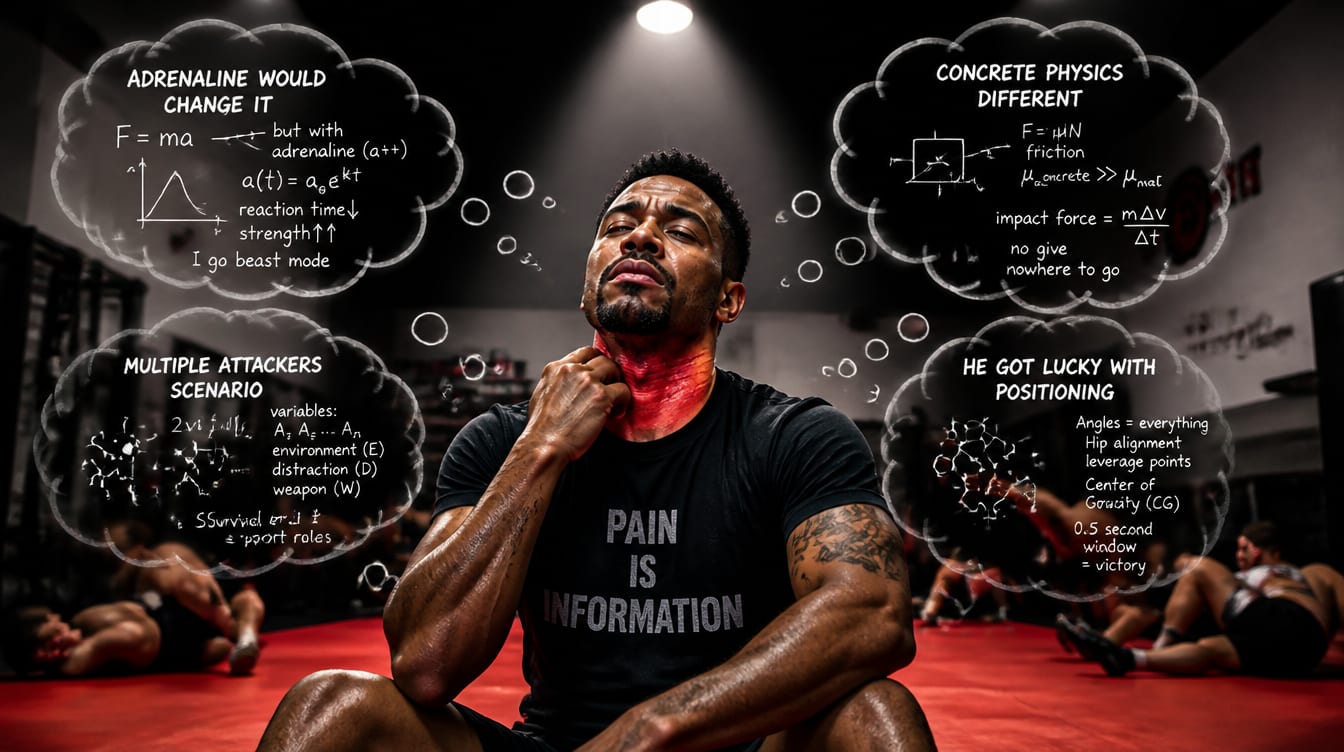
Kevin Brashear, 34, an accounts coordinator at Sutton & Mills Insurance Group in Portland, regained consciousness at 7:16 p.m. on Tuesday after spending four minutes and twelve seconds in a state of complete unconsciousness induced by a properly applied rear-naked choke during evening open mat at Cascade Jiu-Jitsu Academy. By 7:19 p.m., still in the process of remembering where he was and rubbing the deep impressions his training partner’s forearm had left across his neck, Brashear began explaining to third-degree black belt Professor Elena Vasquez why the technique that had just knocked him unconscious would “absolutely not” work in a real street confrontation.
Brashear’s training partner that evening was Marcus Chen, a 28-year-old commercial real estate developer who trains four times per week with the kind of consistent discipline that comes from either genuine passion or someone billing it as business development. Chen had no malice in his application—it was a standard rolling session, the kind that happens thousands of times per day in gyms across the country. The choke was textbook: proper hand placement, control of the posture, a smooth tightening that gave Brashear approximately six seconds of consciousness before blood flow to his brain stopped entirely.
Brashear tapped at 7:15 p.m. Chen released immediately. By 7:16 p.m., Brashear was asleep on the mat, his body limp, his breathing shallow, his consciousness completely absent.
“The thing is,” Brashear said to Elena, his voice still slightly hoarse from the compression, “you can’t do that on the street.” Elena, who has been teaching jiu-jitsu for seventeen years and has heard variations of this exact statement approximately 2,847 times, waited for him to continue.
“Adrenaline,” he said. “You have adrenaline on the street. Plus concrete. The concrete makes a difference. It changes everything.”
Elena asked him a follow-up question: “Have you ever been in a street fight?”

Brashear didn’t answer that question directly. Instead, he said, “That’s different,” and then walked to the water cooler, drank an entire bottle of water in one continuous gulp, and returned to announce that he needed to research “real-world variables” before he could responsibly train chokes anymore. He spent the next seven minutes standing near the observation window, staring at his phone as if the answer to his concerns might appear if he scrolled long enough.
The other twelve students rolling didn’t pause to weigh in on Kevin’s theory. Three of them were newer white belts who did not yet understand the significance of what they were witnessing. Six were purple belts who had heard this argument before and were simply waiting for it to pass like weather. Two were black belts who had heard this argument in multiple languages across three continents. One was Marcus Chen, who was already reviewing video footage of the choke on his phone to see if he could apply it with more technical precision next time, perhaps with a slightly deeper grip angle.
Over the next thirty minutes, Brashear conducted what he described as “informal research.” This research consisted of him scrolling through his phone while standing near the mat, occasionally looking up to ask questions like “But what if the guy was expecting it?” and “What if there were two guys?” and “What if he was on PEDs? I read that PEDs make you harder to choke.”
He had not, in fact, read that. The purple belt closest to him, a woman named Sarah who works as a physical therapist and has heard every variation of this concern, didn’t look up from her training notes and simply said, “Then you’d be unconscious in a street fight instead of here.”
By 7:35 p.m., Brashear had moved on to discussing the concrete issue with more specificity. He had apparently decided, while unconscious, that the composition of the ground surface was a critical variable that martial arts instructors had somehow overlooked for thousands of years. “Modern concrete is different from, like, ancient concrete,” he said to no one in particular. “It’s harder. Maybe. I’m not a concrete expert, but I feel like there’s something there.”
He then asked if anyone knew whether the Roman Empire had rear-naked chokes, and if they did, what they did about the stone roads. No one answered. Sarah continued writing.
Brashear has been training jiu-jitsu for fourteen months. His competition record is 0-2, both losses by submission, both rear-naked chokes, both in divisions where he was the heavier competitor. He has been put to sleep three times in rolling—twice by rear-naked chokes, once by a triangle choke. Each time he regains consciousness, his first instinct is to explain why the technique won’t work on the streets. His training partners have started a betting pool on which technique he’ll be knocked unconscious by next. The current odds favor an armbar. Three people have taken bets on “deep half guard pass into side control.” One person bet on “running out of excuses.”

Elena, who had been observing this entire sequence unfold with the calm of someone who has seen this exact cycle repeat hundreds of times, decided to offer some perspective. “The rear-naked choke,” she said, walking over to where Brashear stood, “works the same way on concrete as it does on a mat. The mechanism is blood flow to the brain. Concrete doesn’t affect blood flow. Physics doesn’t change locations.”
Brashear nodded slowly, as if processing this information at a speed slightly slower than normal conversation. “But,” he said, “the psychological element is different. Your mind is different when you’re in danger.”
Elena asked: “Are you suggesting your mind prevented you from losing consciousness?” Brashear said he would need to “think about that offline” and then turned back to his phone.
By the time the 8 p.m. session ended, Brashear had generated a list of eight additional variables he believed made street-fighting fundamentally different from open mat rolling. The list included: “shoes,” “clothing,” “mental state,” “surprise factor,” “witnesses,” “lighting,” “the vibe,” and “I wasn’t ready.” He had also decided that he would begin training what he called a “street-specific grappling curriculum,” which consists of him asking other students, between rounds of rolling, “But what if..” and then trailing off without completing the thought.
When Elena asked what he planned to do differently in his training going forward, Brashear said he was going to “get used to it.” She asked what he meant by that. “The choke,” he said. “Get used to being choked unconscious. So when it happens on the street, my body will know what to do.”
Elena said, “So you’re going to keep training jiu-jitsu.” Brashear said yes, he was committed to the process. Elena didn’t point out that this was the direct opposite of his entire previous argument. She simply reminded everyone that next week’s class would start at 6:30 p.m., and that if anyone planned to lose consciousness, they should notify her in advance so she could adjust the class plan accordingly.