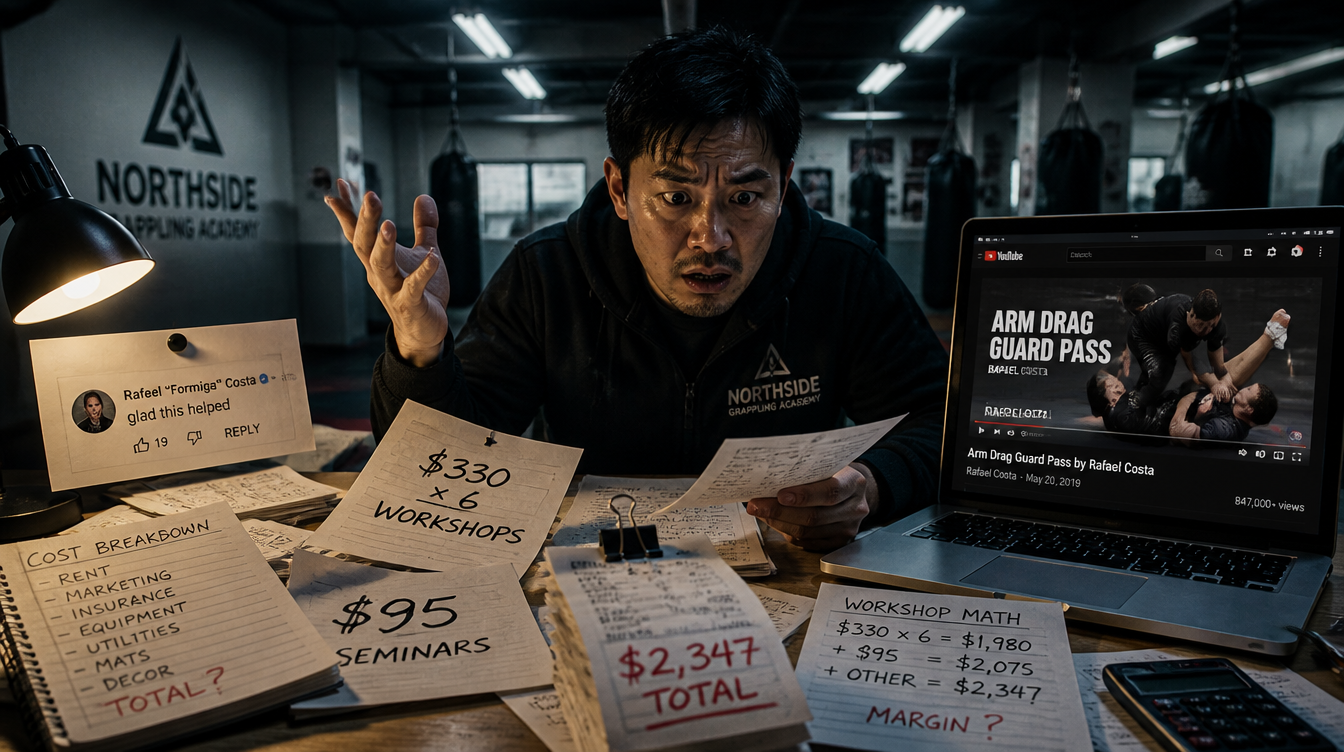
Marcus Pellman, a 28-year-old financial analyst from Boise, Idaho, spent exactly $2,347 over four months at Northside Grappling Academy to learn the arm-drag guard pass, a technique that Rafael Costa posted to YouTube for free on May 12, 2019—a video that now has 847,000 views and a pinned reply from Costa himself saying “glad this helped.” Pellman’s investment included six Tuesday evening workshops at $330 per session, a “digital curriculum package” locked into a 90-day viewing window for $40, a 2.5-hour Saturday seminar titled “Advanced Grip Mechanics” ($95), and a personal coaching consultation where Northside owner David Chen, 34, watched him do the arm drag and said “you’re close” before charging $95 for that observation.
The closest Pellman had come to seeing this exact technique before signing up was in Costa’s May 2019 video, which he eventually watched on June 2, 2026—four days before his final paid workshop ended.
“My whole game shifted,” Pellman said, demonstrating the technique on a reluctant brown belt named Gregory, who tapped the moment Pellman made contact.
Gregory later clarified he’d tapped out of mercy.
“Instructor Chen really synthesizes the information in a way that clicks,” Pellman continued, entirely unaware that he’d clicked it while watching a man in a basement do the same exact thing on his laptop for free.
Chen, who opened Northside three years ago after a two-year hiatus from jiujitsu (“I was getting my MBA”), defends his pricing model with absolute conviction.
“I curate the information,” he said.
“The internet has noise. I filter it. Students come here for guidance, not data.”
When shown Costa’s video—which includes chapters, slow-motion replays, and a detailed breakdown of grip angles—Chen nodded approvingly.
“Yeah, that’s solid. But I teach application. That’s the value.”
Pellman’s training journal, which he’d shared with Chen as part of their professional development, showed that the only “application” difference was self-inflicted: Pellman had been avoiding the arm drag on his left side because he is left-handed and assumed right-side passing was the biological default. Chen never mentioned this. None of the six workshops addressed it either.
Pellman discovered it himself by accident after the fourth session. When asked if he’d tried the left-side version before attending, Pellman went silent.
“I just.. never did,” he said finally.
“That seems like something I should have tried.” Northside’s competitor gym, Eastside Jiu-Jitsu—located two miles away and charging $120/month with unlimited classes—includes the same arm-drag passing sequence as part of their standard curriculum. It’s taught by a white belt named Milo, who’s been training for six weeks and is sponsored by his dad’s car dealership to make it “official.”
Milo learned the technique from a 2017 John Kavanagh YouTube breakdown (different terminology, same grip, zero additional cost). He doesn’t charge extra for the arm drag. He also teaches it wrong sometimes.
No one has complained. There’s an absurd amount of free content about this one technique. Rafael Costa uploaded a progression update in 2021, then again in 2023 (with heel-hook counter-attacks), then again in 2024 (discussing angle adjustments against stronger opponents).
Craig Jones posted a variation in 2020. The Ruotolo twins discussed it during a 2022 seminar now available on FloGrappling ($20/month). Andrew Wiltse released an Instagram Reel titled “The Arm Drag You’re Probably Doing Wrong,” which got 2.1 million views.
There are comment threads—literal essays—where random practitioners have been debating nuances of this one grip for over five years. Pellman, however, had somehow navigated all of this without finding anything. He’d documented his research in a Google spreadsheet for Chen: thirty-seven arm-drag tutorials across YouTube, Instagram, FloGrappling, and a grappling-specific Discord.
Forty-three rows. Thirty-seven videos. He’d ranked them by clarity (mostly 6-7 out of 10) and given each a “cost-benefit score” that assumed all free content was worth at least $30 based on what Chen charged.
By that logic, he’d already received $1,110 in value before paying anything. Yet something was missing. What was missing: explicit permission to use the technique on his weak side.
Chen scheduled a follow-up “advanced grip mechanics” session to address it. Pellman paid $95 for the session. The entire session consisted of Chen watching Pellman arm-drag with his left hand and saying “yeah, that works.”
Pellman asked what was different from the right side. Chen said “footwork” and then didn’t elaborate. Pellman’s footwork on both sides was identical.
He’d copied it from Costa’s 2019 video. By June, Pellman was genuinely confident with the technique. He showed it to his training partner James at open mat, executing a textbook arm drag into a solid bodylock.
James tapped immediately—not because the technique was devastating, but because he’d hyperextended his knee the day before and was terrified of any pressure near the joint. Pellman texted Chen within minutes: “The arm drag works perfectly. My training partner couldn’t defend it.”
Chen replied: “See? Advanced training.” James later clarified he’d been injured and had simply been afraid.
Northside’s July schedule now includes a four-week seminar titled “Beyond the Basics: The Heel Hook System Nobody Is Teaching.” The course runs $280/session, four sessions total, with a digital guide ($50) and a one-on-one consultation ($95). The description promises that heel hooks are “misunderstood in most online content.”
Three major YouTube channels released comprehensive heel-hook tutorials in the last six weeks. Pellman has already registered for all four sessions and requested a payment plan. He’s also considering enrolling in Chen’s next module: “Escaping the Top Position—Advanced Concepts.”
Rafael Costa posted an eleven-minute breakdown of this exact topic to YouTube in October 2020, complete with timestamped chapters. Pellman hasn’t found it yet. He’s now searching for Brazilian arm-drag tutorials on YouTube, figuring the original Portuguese must contain something the English internet missed.
He doesn’t speak Portuguese. He’s used Google Translate three times. Last week, Pellman discovered that the arm drag he’d paid $2,347 to learn was trending on TikTok, demonstrated by a 16-year-old white belt from Nebraska who posted it once and never posted again.
The video has 1.2 million views. No one credits the source. Pellman watched it four times, taking notes on the kid’s grip angle, which was identical to his own.
He texted Chen asking if they should offer the Nebraska kid a sponsorship deal. Chen didn’t respond for six hours. When he did, he’d already launched a new workshop: “TikTok Arm Drag Mastery—What the Algorithm Got Wrong.” $330/session.
Six weeks. Pellman is registered.