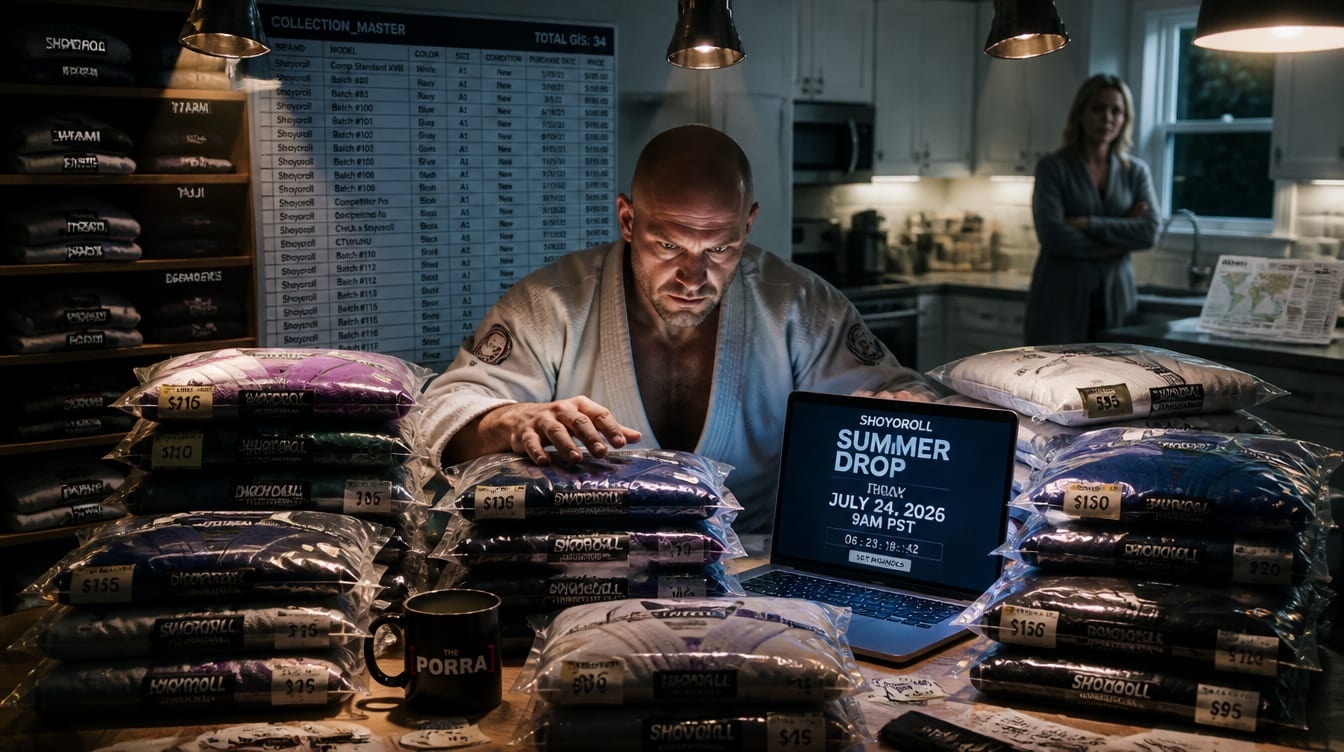
Andrew Matheson, a 38-year-old brown belt at Riviera Jiu-Jitsu in San Diego, cancelled a seven-day Hawaiian vacation scheduled for July 23–30 after receiving an email notification from Shoyoroll announcing their Summer Drop collection on July 24, 2026. The cancellation cost him $1,200 in non-refundable airline tickets. His wife, Jennifer, sat across from him at the kitchen table as he explained his reasoning. “The limited quantities won’t wait,” Matheson said. “I need to stay focused on the mats.” He didn’t offer to repay the flights. The resort, a beachfront property in Maui with a spa that Jennifer had researched for six weeks, remained booked under a name they would not be traveling under.
The decision to forfeit vacation days and airfare for a gear drop makes more sense when you examine the current state of Andrew Matheson’s gi collection. Seventeen Shoyorolls. Eleven of them—nearly two-thirds of his Shoyoroll inventory—still in original packaging with price tags on the plastic. These tags range from $85 for a basic colorway to $210 for limited collaboration editions with artists whose work he does not follow. His complete gi inventory across all brands totals thirty-four units: Shoyoroll, Tatami, Fuji, Gameness, Origin, and an experimental nylon gi from a company that ceased operations in 2019. Total retail value: approximately $4,600. He’s never told his wife the actual number. A spreadsheet on his laptop titled ‘COLLECTION_MASTER’ tracks each gi with the precision of a museum catalog: brand, size, weight category, color designation, sleeve length, purchased date, retail cost, current condition code, and training frequency tier. Unworn units get flagged in conditional formatting. The file was last updated three hours before he called the airline to cancel.
Jennifer Matheson, who works in pharmaceutical sales and is accustomed to managing competing priorities, had approved the Hawaii trip in March. “We had already paid the deposit on the condo,” she recalled, speaking by phone from her office on Thursday. “He was excited about it. He picked the resort, he made the reservation, he bought the tickets. Then the email came. It was like watching someone choose between their spouse and their gym. Except the gym wasn’t asking him to stay. A company he’ll never meet was.” She paused. “He showed me the email. It said ‘Limited Quantities.’ Like that was an explanation.”
The Hawaii cancellation is not Matheson’s first sacrifice to gear acquisition. In 2024, he declined an invitation to his brother-in-law’s wedding in Colorado. His reason: a Tatami black-belt gi drop was scheduled for the same weekend, and he’d received an early-access link. He bought two—one size A2 and one size A2L, though he only wears A2. Both remain unworn. He has since adopted a policy of not accepting out-of-state invitations during “drop season,” which he defines as March through October.

Matheson’s actual commitment to training is quantifiable through his gym membership account. Riviera tracks attendance, and the data is unforgiving: he averages 1.5 classes per week. Some weeks zero. The $200 monthly unlimited membership costs him roughly $67 per attended class. His last competition was eighteen months ago—a local tournament where he placed third in his division and didn’t return. His most recent rolling session lasted nineteen minutes before he cited shoulder discomfort and left the mats. The same shoulder, interestingly, had no trouble supporting three hours of browsing Shoyoroll’s Summer Drop preview on Sunday evening, scrolling through colorway options while sitting on the couch next to Jennifer, who was watching television with her phone on silent.
The logistics of the Summer Drop had occupied his mind since the preview email arrived on July 18. Shoyoroll announced a 3–5 business day shipping window for orders placed on July 24. Matheson calculated the possibilities: if ordered Thursday morning, delivery could arrive as early as Friday afternoon. As late as Tuesday morning. The window was, in his assessment, too wide for comfort. He needed to be home. He needed certainty.
On Wednesday morning, Matheson called Riviera Jiu-Jitsu from his car during a work break. He asked for Marcus Chen, the gym’s assistant manager. “Can you hold a gi for me if I miss Friday through Monday?” Matheson asked. Chen, assuming a loaner situation, said they had plenty of training gis available. “No,” Matheson said. “I’m ordering a Shoyoroll tomorrow. Summer Drop. I need to be home when it arrives. Can you just—if I can’t make it, can you hold a gi?” Marcus offered an alternative, the kind that sounds reasonable when you say it out loud: “You could train Thursday. Then come back Tuesday once the package is here. You’ll have most of the week.” Matheson’s response came slowly. “I can’t. I have to be there. For the delivery. The drop window is small. This is a new phase for me, Marcus. I’m really focusing on training—but the timing is critical.” “It’s a gi,” Marcus said. “It’s a Shoyoroll,” Matheson corrected, as though this explained everything.
The contradiction—“focusing on training” versus “I can’t train because I might miss a package delivery”—didn’t resolve in Matheson’s mind. It just coexisted there—two truths that cancelled each other out. When the gi arrived on July 26 at 2:47 p.m., Jennifer was home. She photographed it on the counter—unopened, price tag facing upward—and sent the image to Andrew at work with no caption. He called her at 4 p.m. asking if they could talk about it that evening. They did not talk about it that evening.

Three of Matheson’s training partners at Riviera confirmed he had not been on the mats since before the Hawaii cancellation. One of them, a purple belt named David, said Matheson had posted in their WhatsApp group that he was entering “a new training phase focused on foundational equipment investment.” Another said, “He showed up last Tuesday just to sit on the bench. He wasn’t in a gi. He was tracking a package on his phone.”
Shoyoroll’s marketing department declined to comment on whether they saw unusual cancellation patterns around their Summer Drops, though an employee who spoke on condition of anonymity said this scenario “is absolutely not uncommon.” She added: “We’ve seen people skip family events. Weddings. Funerals, I think, though nobody’s told us that directly. The notifications create a sense of urgency. And then the customer has to be home to receive it, right? That’s how packages work.”
The COLLECTION_MASTER spreadsheet has been updated since the drop arrived. The new Shoyoroll now appears in the “tested” category—which, in Matheson’s system, means tried on exactly once in the house before being photographed from three angles and filed. The price tag remains affixed, documented in his phone’s “GI_DOCUMENTATION” folder alongside historical images of every other purchase, many of which he will never wear. Jennifer mentioned Hawaii once more, in passing, on Saturday. She said the resort was offering the next available dates for rebooking at double the original cost, or a refund of 60 percent of what they’d paid. Matheson said he’d think about it. By Sunday, he was already signed up for Shoyoroll’s September drop notification email.