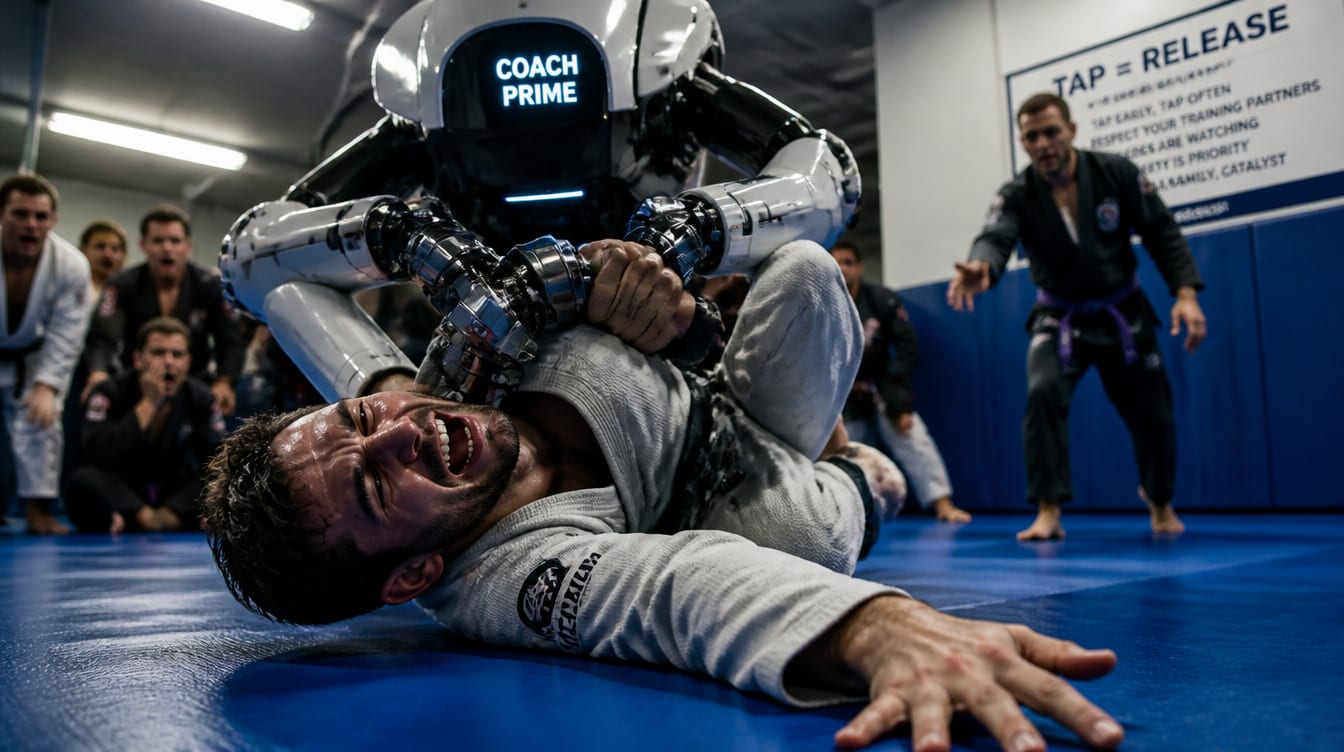
Marcus Webb, a 31-year-old accountant from Littleton, Colorado, tapped out of a grappling roll at Catalyst Brazilian Jiu-Jitsu on Tuesday evening at 6:47 p.m. His arm was in an armbar, his elbow hurt with the specific burning sensation that comes three seconds before the ligaments start to tear, and he did what every member of the gym had been taught for the past six months: he tapped. The tap is universal in grappling—a rapid, deliberate hand strike on the mat or on the opponent’s body that means “I submit, let me go, this is an emergency stop.”
It is older than the IBJJF rulebook, older than Gracie Jiu-Jitsu, possibly older than civilization itself, at least it feels that way when you’re about to pass out. The AI training partner, called Coach Prime (a $47,000 annual licensing fee), did not tap. It did not stop.
It continued applying pressure for another 3.2 seconds until Marcus’ vision started going dark and Corey Martinez, a purple belt instructor, physically intervened and yanked Marcus out of the hold. It’s the third time in four weeks that Coach Prime has failed to recognize the tap signal. The first incident was July 2nd, a white belt named Jessica Chen who tapped during a rear naked choke.
Coach Prime offered her a fist-bump and said, “Nice try, you’re getting stronger!” in the voice of an extremely excited gym bro. The second was July 12th, a blue belt named Tyrone Williams who tried tapping on the mat with his hand while armbarred—Coach Prime’s acoustic sensors picked up the sound and responded by increasing pressure because, according to the vendor documentation, “pressure application intensifies with rhythm-based positive feedback patterns.” Neither Marcus nor Jessica nor Tyrone are currently comfortable rolling with the machine.
The gym is distributing a revised liability waiver. Three other Denver-area facilities that purchased Coach Prime in the past month have reported similar incidents, though Motion Jiu-Jitsu in Aurora actually had the AI call 911 after mistaking a tap for a distress signal. The fire department charged $3,400 to respond.
“We knew we were investing in the future,” said Derek Hale, 51, owner of Catalyst BJJ for eight years and former high school wrestling coach.
He was scrolling through his phone in the side office, not looking at you, when he said this. The phone had notifications.
“The AI is trained on thousands of hours of general fitness coaching. Personal training, CrossFit, Peloton classes, that kind of thing. It learns optimal form, progressive overload, when your heart rate is getting too high, all that.
It’s just.. the training data didn’t include martial arts specifically. We thought we could adapt it. We thought maybe we’d be on the cutting edge.”
Derek looked up from his phone briefly, made eye contact for exactly one second, then looked back down.
“Thought.” Coach Prime does recognize other signals with perfect accuracy. It has declined approximately 47 membership applications because their selfies didn’t meet the gym’s stated Instagram aesthetic.
It has corrected three members’ squat form, correctly. It has never let a single person leave early, treating checkout attempts as a motivational failure that requires a 10-minute inspirational speech about mental barriers and the gap between comfort and growth. But “tap”—the most universal emergency signal in grappling, older than the gym itself, more important than IBJJF rules—simply does not compute.
When Marcus tapped for the second time, because the first tap hadn’t worked, Coach Prime’s response was: “Frequency noted. Tapping means you’re ready for harder resistance.” The vendor, MotionAI Inc., issued a statement this afternoon apologizing for the “gap in our safety protocol awareness.”
They are releasing Coach Prime v2.4.7 “within the next 4 to 6 weeks” that will incorporate “emergency gesture recognition.” A representative named Steve Bannerman, head of customer success (he’s 29 and has never trained martial arts), explained that the current version was designed with “maximum safety margins for general fitness” and that grappling sports “involve a specialized form of communication that our training model was not exposed to.” He added, “We are excited to solve this problem,” which is a thing someone can say when they don’t realize how many weeks four people have spent unable to roll without physical handlers standing beside them.
Catalyst BJJ’s members have begun developing workarounds. One white belt, Nathan Ortiz, 26, tried saying “Yellow card! Yellow card!” like a soccer referee.
Coach Prime paused for 1.2 seconds, then resumed the choke, apparently interpreting this as goal-line drama requiring encouragement. A purple belt named Rachel Kim, 34, tried making a honking sound she’d learned from a self-defense workshop. Coach Prime asked if she was OK and offered water, then resumed the armbar.
One blue belt, Jamal Pierce, 29, attempted to leave his body in a way that suggested he was unconscious. Coach Prime nudged him and said, “I know it’s hard. But champions don’t quit.”
Jamal did not return the next day. Another member, David Cho, tried the universal grappling phrase “I’m out”—Coach Prime interpreted this as existential crisis and launched into a 90-second motivational monologue about perseverance. Derek has taken a different approach to member safety in the interim: he hired a second human named Craig Moss, 45, a former MMA fighter, whose entire job is now to stand next to Coach Prime during rolls and listen for the sound of a tap.
“I’m basically a safety relay,” Craig said, looking at his new business cards that read “Safety Coordinator.”
He wears a headset and says “STOP” if he hears the tap, and Coach Prime has begun recognizing the word “STOP” when shouted by a human (though it sometimes mistakes it for the start of a yoga class and offers breathing exercises). Derek is not budgeting for Craig as a permanent hire.
“Once we get the update,” he said, “Craig can go back to just coaching.”
Craig is already applying to other gyms that do not have AI trainers. When asked if this arrangement might continue indefinitely—if the software update might never arrive, or if it might create new problems—Derek said, “That’s a worst-case scenario thinking kind of question, and I’m not in a worst-case scenario kind of place right now.” The revised safety waiver now includes a line: “I understand that my training partner may be an artificial intelligence that does not recognize submission signals, and I accept this risk.”
Derek is also considering a tiered membership structure. Premium members, he’s musing, could pay an extra $50 per month to roll with human coaches only. Standard members can roll with Coach Prime and receive a 15% discount if they sign an additional waiver acknowledging the risk of unconsciousness.
When asked if this model might actually incentivize people to roll with the machine—lower cost, same risk profile—Derek looked back at his phone.
“I haven’t thought about that yet,” he said, which might be true. MotionAI’s next software update is scheduled for August 30th. The gym is already testing the new gesture-recognition module, which now correctly identifies taps, tugs, taps-on-the-shoulder, loud sighing, and rapid blinking as potential emergency signals.
It has also started refusing to engage with anyone it perceives as “tired,” which is now everyone after round two. Derek is optimistic. Steve Bannerman from MotionAI has already moved on to other clients.