Marcus Devereaux, 38, opened Zenith Combat Systems in suburban Denver in March 2024 with $147,000 in equipment financing and a business plan that hemorrhaged roughly $8,000 per month until June 2026, when he introduced the Mentality-Based Black Belt Track — a 12-week certification program that costs $4,200 and requires zero mat time, zero sparring, and zero physical contact with another human being. The track is currently enrolled by seven people, including Devereaux’s ex-wife’s new boyfriend Tyler, who attended one class in 2019, got caught in an omoplata, and decided that the mental journey of jiu-jitsu was “the real belt.” The program operates out of a converted conference room at Zenith, formerly used for the gym’s failed “visualization pod” initiative (a $12,000 investment that yielded exactly one client, who fell asleep and never returned). Devereaux positions the Mentality-Based Track as a “radical reimagining of how we measure martial competency” — a phrase he lifted directly from a Tony Robbins YouTube video at 2:47 a.m. on a Tuesday. Here’s how it works: participants attend four 90-minute weekly sessions for 12 weeks. Each session consists of Devereaux (or his brother-in-law Craig, a substitute instructor who works in insurance) leading the group through a curriculum that includes breathing exercises, motivational TED Talk excerpts read aloud, a 40-minute segment on “the philosophy of the armbar,” and a role-playing exercise called “Recognize Your Inner Black Belt” where participants close their eyes and imagine themselves executing techniques they have never physically attempted. There is also a final exam: a written essay (500-1000 words) on the topic “Why I Deserve This Belt.” No word minimum is enforced; Tyler’s submission was 247 words and consisted mostly of “because i’ve been through a lot and I deserve this.” Devereaux’s marketing copy describes the track as “for the student who has already put in the hard work mentally, and is simply waiting for the belt to catch up.” In practice, this means people who either (a) train at other gyms and want a credential without portability, (b) trained once and felt spiritually wounded by the experience, or (c) genuinely believe that confidence is a substitute for technique. A woman named Renee, 41, joined the track because she watched Anderson Silva fight Israel Adesanya on UFC’s YouTube channel and felt “emotionally connected to the grappling journey,” despite never stepping on a mat. Renee now tells people at dinner parties that she earned a black belt. The intellectual framework that launched this program came to Devereaux after a 6 a.m. panic-scroll through Instagram, where he discovered a post from a life coach in Austin claiming that “limiting beliefs about the body are why people don’t achieve their physical potential.” Devereaux, who owns the gym but does not teach classes (he franchised the instruction out to whoever needs cash that month), interpreted this to mean that actual training was the limiting belief. The solution seemed obvious: cut out the middleman (training itself) and sell the transformation story. An actual black belt from a traditional lineage gym across town, Marcus Hernandez, heard about the program and visited Zenith to observe a session. He described what he saw: seven people sitting in yoga mats, eyes closed, with Devereaux narrating a guided visualization in which participants were “sinking their hips into a deep control position while their opponent’s will crumbles beneath them.” One participant, a man named Derek, was quietly crying — not because he was moved, but because his sciatica was acting up. Marcus left after 12 minutes and never spoke of it again, the way you don’t speak of witnessing a crime you’re too tired to report. Devereaux’s business partner (his accountant, who has no stake in the gym but attends meetings to be supportive) raised a practical question: “Aren’t you concerned that someone might try to use this belt in an actual sparring situation?” Devereaux responded that this was “not his responsibility,” adding that Zenith had a strict liability waiver that technically exempted the gym from injuries sustained by black belts who lacked the physical ability to defend themselves. The waiver, drafted by Devereaux’s neighbor Steve (a tax attorney, not a personal injury attorney), was never actually reviewed by anyone with relevant credentials. Two participants have already mentioned the black belt on their LinkedIn profiles under “Certifications.” One listed it in a job application to a private security company. That application was immediately rejected, but not before a recruiter sent a follow-up email asking Devereaux to clarify whether the MCBBT (Mentality-Certified Black Belt Track) was “an accredited jiu-jitsu credential or a life coaching certificate.” Devereaux never responded, which was the correct move. The program’s graduation ceremony is scheduled for September 2026. Devereaux is considering renting a small chapel and having participants exchange white belts for black ones as a symbolic gesture, despite the fact that none of them actually own a white belt. He is also exploring a companion program called the “Embodied Purple Belt Express” and, for those with less patience, a one-day “Noon-to-Night Brown Belt Intensive” where participants watch technique videos and take notes. When asked if the track might damage Zenith’s credibility with serious students, Devereaux noted that serious students are “not his business model anymore,” and that the Mentality-Based Track generates more revenue per participant per month than actual training because there’s no instructor liability, no mat wear, no insurance premium bump, and no risk of anyone accidentally catching him in a triangle and reminding him that his own game is nonexistent. He has set a sales target of 40 participants by Q1 2027. Tyler, the ex-girlfriend’s boyfriend, wears his Mentality-Based Black Belt to the grocery store. Nobody questions it because nobody knows what it is. Last week, an actual blue belt from a real gym saw it and asked Tyler how long he’d been training. Tyler paused, considered the spiritual truth of the moment, and said, “Since before you were ready to hear it.”
Denver Gym's $4,200 'Mentality-Based' Black Belt
Denver gym offers a $4,200 'mentality-based' black belt certification that eliminates the unnecessary step of actually training on the mat.
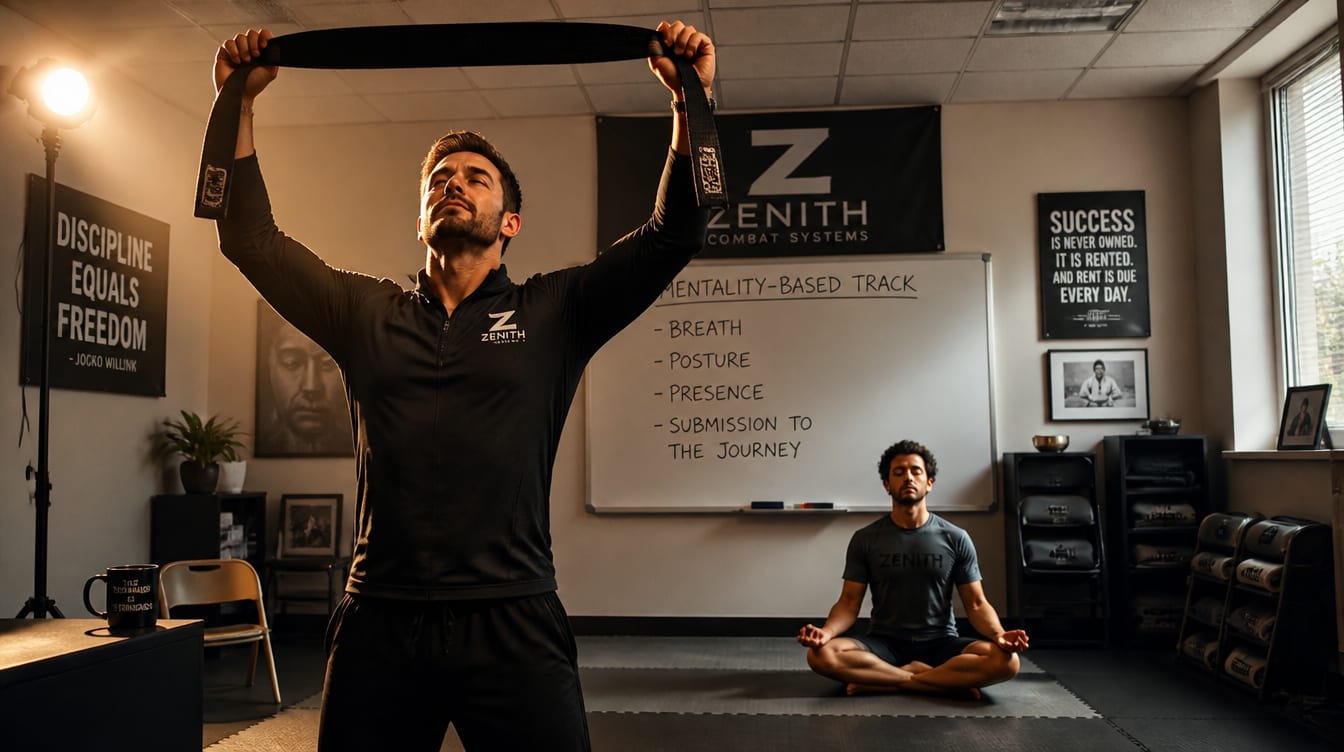
Image generated by AI / BJJ Digest
AI-generated satire. This article was written by an AI trained on years of BJJ content. None of this is real news. Do not cite The Porra in legal proceedings, belt promotions, or arguments with your professor.