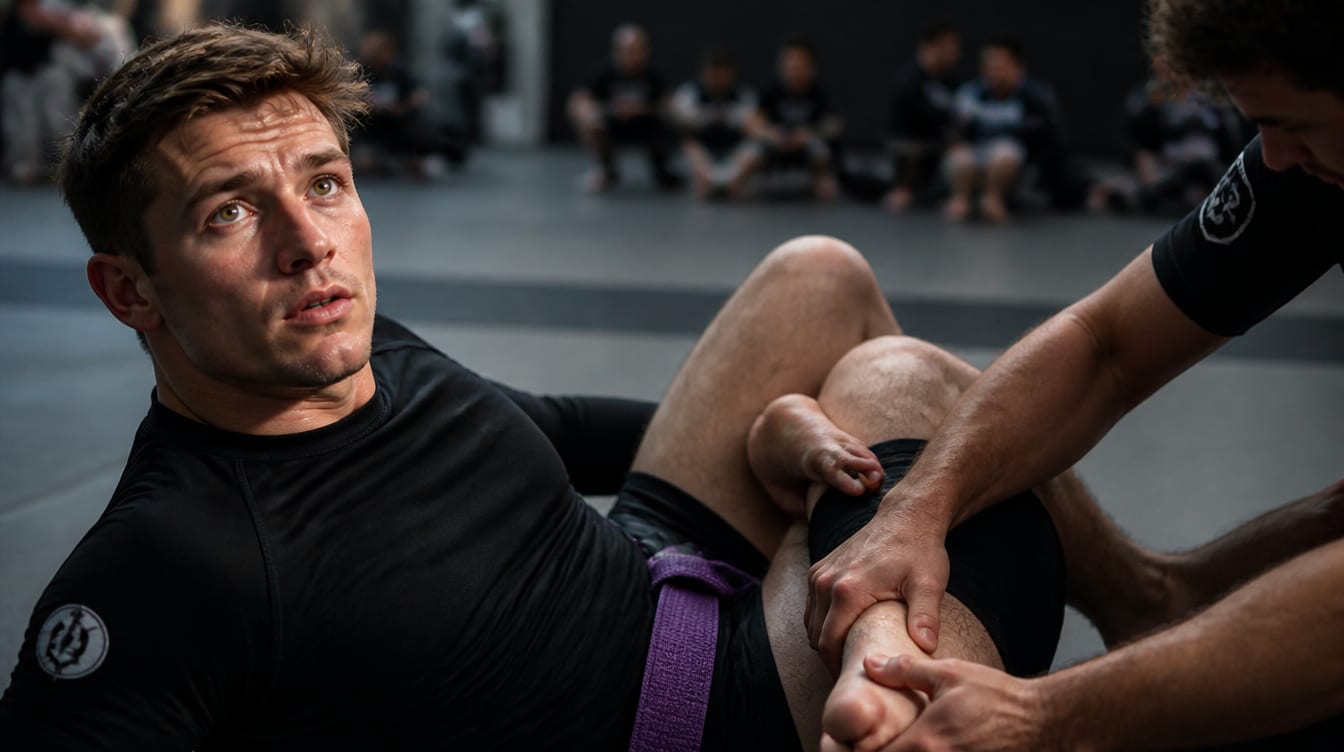
Kevin Reeves, 28, a purple belt at Crown BJJ in Nashville, arrived for Tuesday evening open mat with a specific request. His left knee has been finicky since a poorly-executed heel hook defense the previous week, and he’d been nursing it through Monday’s class. Nathan Carlisle, also purple, had been his training partner for three months. Kevin pulled him aside during the warmup: “Hey, I’m dealing with knee stuff this week — can we avoid heel hooks?” Nathan nodded enthusiastically. “Totally, I hear you. We’ll keep it light.” Kevin felt relieved.
The rolling started. They moved through the first two minutes in what could generously be described as a flow roll — mostly grip-fighting, some minor position shifts, the kind of casual rolling that happens when two people are genuinely trying not to hurt each other. Kevin worked a collar drag. Nathan shrimped out. Kevin reset. Nathan was being respectful.
45 seconds in — Kevin would check the round timer later to confirm the exact moment — Kevin got Nathan into a 50/50 position from bottom. Nathan’s face changed. He’d just remembered what he was actually capable of. Kevin felt the leg lock setup begin. “Bro—” Kevin started. Nathan was already mid-attack. Heel hook. Fast. Clean setup. Kevin tapped before his knee bent further. Nathan released immediately, genuinely shocked at himself. “Oh man, I forgot — my bad! I was just thinking about the technique and my body just went there.” He’d been thinking about heel hooks for four seconds.
Kevin’s knee throbbed. He sat out for one round. When he got back in, he made the same request to Marcus Webb, a brown belt visiting from Memphis. Marcus was even more committed to hearing the request. “Absolutely, brother. Injured knees are sacred. We protect that.” Marcus meant it. Kevin could tell by his tone.

Ninety seconds into their roll, Marcus got comfortable on top in side control. He felt Kevin’s leg nearby. He transitioned into 50/50 and was attacking the heel hook before Kevin could set his defense. Kevin tapped instantly. Marcus stopped, seemed genuinely confused. “Wait, didn’t you say something about your knee?” Yes. Twenty-three seconds ago. Marcus shrugged. “Yeah, but you said avoid heel hooks — I got you in a leg lock, which is different.” It was not different. Marcus saw the confusion on Kevin’s face and tried to clarify: “See, I’m attacking the ankle more than the heel. Technically, heel hooks are just one type of leg lock.” Kevin’s knee disagreed with this categorization.
The following Tuesday, Kevin showed up with a more elaborate setup to his boundary-setting. He got Nathan aside again — the same Nathan from the week before — and was very specific: “My knee is still bugging me. No leg locks of any kind. None. Heel hooks, knee reaps, foot locks, ankle locks, nothing.” Nathan took it like a sacred oath. “We’re just flowing, man. I got you.” This time Nathan lasted 31 seconds before forgetting.
Kevin was recovering from a guard pass attempt when Nathan slipped into a footlock position — not a heel hook, technically, but one of the eight other leg lock variations Kevin had specifically eliminated. Kevin tapped. Nathan seemed genuinely surprised he’d done it. “You said no heel hooks,” Nathan offered, as if the other seven leg lock variations had never been mentioned. “I didn’t touch your heel.”
By the third week, something had shifted in Crown BJJ’s open mat culture. Kevin stopped making requests. He’d told five different partners not to attack his knee. He’d been caught in six leg locks. The success rate of partners remembering his injury status for longer than the duration of a single breath was approaching statistical significance — and that significance was basically never.
A visiting white belt had asked for no pressure passing because he had a bruised shoulder. He got smashed from above for two minutes. A 16-year-old explained she had lower back pain in certain positions. She got caught in a d’Arce choke 45 seconds later—from someone who’d “forgotten.” One coach smiled when told a visiting athlete wanted to avoid leglock training. “That’s cute,” he said. Then he spent four minutes teaching heel hook anatomy on the visitor’s right leg.

The gym’s owner, Derek Philips, eventually did a survey. Out of 62 open mat attendees over two weeks, 58 had requested to avoid a specific technique or position due to injury. The compliance rate? The median time before the boundary was violated? Four seconds. Fifty-three of the 58 requests were violated. The five that weren’t involved partners who’d simply rolled with someone else entirely.
Derek put up a laminated sign on the bulletin board: “Open Mat Etiquette Reminders: Listen to your partner’s requests.” He added an asterisk. “Your brain has about 4 seconds to integrate the new information before your muscle memory takes over.”
Kevin now just shows up and rolls. He’s accepted that communication at Crown BJJ operates on the 4-second protocol. You can explain something to your training partner. You can be sincere. They can even acknowledge you verbally and establish eye contact that demonstrates comprehension. And then their body — freed from the constraints of their conscious intentions — will do exactly what it was trained to do.
Nathan still apologizes every time. Kevin’s still injured. But they keep rolling, because that’s what you do. You just spend the first four seconds hoping your partner remembers, and the rest of the round rolling very defensively against someone who’s forgotten your entire medical history in a single breath cycle. The knee’s probably going to need surgery eventually. But at least it’ll be an interesting story: “Yeah, I got it from my training partner violating a boundary in real-time. Multiple times. At one gym. Over the course of three weeks. It was very consistent.”