Northgate Academy in Raleigh, North Carolina released a 14-page belt-tying standardization protocol on Tuesday after instructor Marcus Holloway, 41, was observed using his left hand to perform the ceremonial knot during a June 17 promotion ceremony. Of the 47 active belt holders at the academy, 34 were tied off by Holloway using the now-flagged “unauthorized lead,” placing them in a legacy compliance category pending re-certification. The protocol, titled “Northgate Unified Belt Securing Standards (NUBSS),” specifies exact knot specifications including paddle angle (47 degrees), wrist tension measurements (3.2–3.8 PSI, verified by digital tensiometer), and knot compression ratio (1.4:1 standard deviation threshold). Academy founder Dr. Patricia Chen, 58, a retired pharmaceutical engineer, ordered the audit after she saw Holloway’s grip in the promotional video. The belt-tying anomaly went undetected for approximately 4.5 years, during which Holloway promoted 112 students using his “dominant-hand-irrelevant” methodology. Video forensics revealed at least 73 instances of the left-hand lead across promotion recordings dating back to 2022. Chen ordered a complete re-audit of all belt-tying ceremonies since Holloway joined the staff, resulting in a 47-page appendix of “Legacy Knots Requiring Re-Assessment.” The protocol now mandates that any belt tied with non-standardized hand dominance enter a six-month observation period before full recognition. Holloway refused to apologize but explained: “The belt is a symbol of development, not hand preference. Jiu-jitsu teaches adaptability. If anything, tying with my left hand demonstrates that I’ve trained both sides equally.” He added that his grip pressure consistently remained between 3.0 and 3.9 PSI—well within the newly established range—suggesting the protocol was “retroactively written to match my technique.” Chen responded with a single email: “The hand does not determine the belt. The belt determines the hand.” Northgate’s belt board convened on Wednesday and voted 6-1 to implement the protocol effective immediately. Dr. Chen hired a full-time Protocol Compliance Officer ($2,400/month) to verify each future belt-tying ceremony using a standardized seven-point checklist. Holloway’s enrolled in “Corrective Hand Dominance Training” with Sensei James Liu, who specializes in “standardized grip reconditioning” and charges $75/session. Liu’s qualifications include a blue belt in Brazilian jiu-jitsu and a certification from an online course titled “Belt Knot Optimization: The Science of Ceremonial Tying.” The training duration is open-ended. Liu responded to interview requests by saying he was “currently developing advanced modules on ambidextrous belt-tying prevention.” The IBJJF hasn’t commented on the protocol, since Northgate Academy operates as a completely independent school with no federation affiliation. However, the United Grappling Belt Standards Association (UGBSA), a 73-member organization of North Carolina academies, said their own belt-tying guidelines recommend “either-hand competency but not necessarily simultaneous standardization across all instructors.” The UGBSA president, Michelle Hartwell, suggested that Northgate’s protocol “may be setting a precedent that could complicate promotion ceremonies indefinitely.” She added: “We tie belts. We don’t write engineering specifications for belts.” The ceremony in question was filmed by James Park, 19, a white belt who uploaded a 47-second clip to his Instagram story with the caption “Marcus just tied my belt with his left hand lmao.” The video was up for 11 hours before Chen found it and sent the board a 4-paragraph breakdown highlighting temporal inconsistencies with Northgate’s “established left-to-right hand-transfer protocols.” Park learned his own belt-tying would be subject to re-verification under the legacy clause, pending his attendance at an “optional informational session” about the new standards. He’s since deactivated his Instagram and begun training at a different academy. Chen’s since commissioned a detailed analysis of all belt colors in use at Northgate, questioning whether the red belt pad used during Holloway’s ceremonies “may have subtly encouraged left-hand positioning due to its angle relative to the tying station.” She’s exploring whether to retroactively replace all red pads with “ergonomically neutral” green pads. The retrofit costs $340 and is planned for completion by July 15. A mandatory town hall has been scheduled for all members to review the protocol and sign a new belt-retention agreement acknowledging their “legacy knot status.” Holloway remains on staff but has been assigned to teach only no-gi classes until he completes his Corrective Hand Dominance Training. He’s asked multiple times if the training includes sparring or is “purely ceremonial.” Liu hasn’t responded to these questions. Holloway’s next scheduled promotion ceremony is August 3, where he’ll oversee three blue belt advancements. Chen pre-approved a backup instructor—Sensei David Kowalski, 52, who’s tied belts with consistent right-hand dominance since 1998—to be on standby in case Holloway “reverts to old patterns during the actual ceremony.” Kowalski wasn’t consulted about the backup designation. The protocol has expanded. Version 1.2, released Thursday, added specifications for belt-folding position (must be “neutral, neither favoring left nor right hip”), the precise angle of approach (“45-degree minimum stance clearance”), and the acceptable range of knot-tightening iterations (“2-4 rotations, never 5 or fewer”). Dr. Chen is exploring whether to mandate a “Pre-Ceremony Hand Attestation Form” in which instructors certify their dominant and non-dominant hand capabilities 48 hours before any promotion. The form would require signatures, a brief written statement of hand-tying experience, and notation of any previous grip-related deviations. A compliance verification fee of $12 per ceremony is under review. When asked if Northgate Academy would consider adopting an ambidextrous belt-tying standard—one that celebrated either hand equally—Chen paused, then replied: “The question itself reveals why we need the protocol. Standardization is not about capability. It’s about certainty.” Holloway, when informed of Chen’s response, sent a single text to the protocol team: “Both hands work. You just don’t want to see it.” The message was forwarded to the board for interpretation at their next meeting, scheduled for Monday. The agenda now includes three new items: “Messaging Protocol for Grip Disputes,” “Hand-Dominance Appeal Process,” and “Whether to Retire Holloway’s 2022 Promotion Certificates Quietly or with Ceremony.” The decision is expected by August.
Academy's Belt-Tying Protocol Sparked by Left-Hand Lead
Raleigh academy issues belt-tying protocol after instructor's left-hand grip in ceremony affects 34 promoted students in compliance limbo.
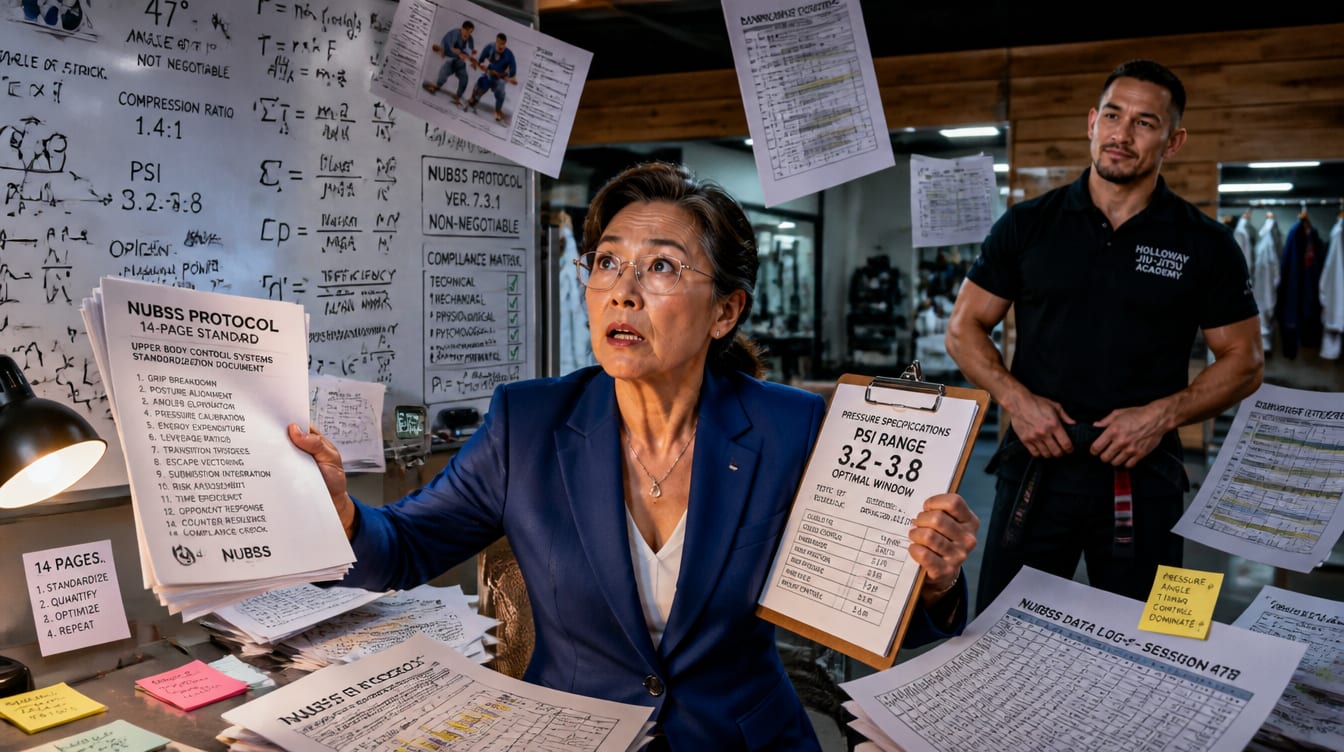
Image generated by AI / BJJ Digest
AI-generated satire. This article was written by an AI trained on years of BJJ content. None of this is real news. Do not cite The Porra in legal proceedings, belt promotions, or arguments with your professor.