Derek Finley, owner of the Midwest Combat Alliance, a Des Moines-based regional MMA promotion operating since 2017, made a discovery on June 15 that nobody anticipated: The Submission Junkies, a classic rock cover band from Council Bluffs hired to perform post-fight entertainment, played for 47 minutes. The two fighters on that card, Derek Volkov and Marcus Chen, had been contracted with MCA for a combined total of 5 fights spanning 14 months and 11 months respectively. The band was paid $1,200 for the night; the fighters received $500 show fees each. Volkov, 31, a journeyman heavyweight who trained at three different gyms during his MCA tenure, appeared on the promotion’s card in November 2024, February 2025, and June 2025. Chen, 28, competed for MCA twice: once in March 2025 as a short-notice fill-in and again in June 2025 as a main event challenger. The main event lasted 2 minutes and 14 seconds (Volkov submission). The co-main event went the full three rounds (Chen lost a decision). The band’s contract, drafted by Finley himself in 35 minutes during a Tuesday evening, specified “post-fight performance duration to be decided by crowd energy and song selection.” The crowd’s energy was moderate. The band selected five songs. They were committed to all five. Finley, speaking from the MCA office—a 1,200-square-foot warehouse space in an office park on the southeast edge of Des Moines that doubles as a personal training facility on weekdays—explained his vision: “We wanted the crowd to leave feeling like they got their money’s worth. The music was the part that really connected. Most fight promotions go all drama and technique. We’re saying: what if people came for the fights but stayed for the rock?” The Submission Junkies have been performing together since 2012. Tom Reno, 46, lead vocalist, his brother Michael Reno on drums, Derek Johansen on bass, and Paul Wetzel on keyboards play 80-90 weddings, corporate events, and private parties per year throughout Nebraska and Iowa. In 2019, they recorded two original songs and posted them to Spotify. As of June 2026, they have 23 total followers on the platform and zero streams on the original material. The June 15 MCA event was their largest audience to date—420 paid attendees. Tom Reno later texted Finley: “This was the biggest show of our lives. We absolutely crushed it. The crowd was into it. Michael was crying during ‘Free Bird.’” The crowd’s apparent enthusiasm was actually people checking their phones during the band’s third song. Neither fighter was present for most of the performance. Volkov, who won via submission, waited by the cage for 11 minutes expecting an in-cage interview. The MC, a local radio personality named Dave Hutchins whom Finley hired unpaid in exchange for promotion of future events, lost track of time during the band’s third song—a 6-minute rendition of “Hotel California.” Hutchins forgot to call Volkov over to the microphone. When Volkov eventually returned to the locker room, a fan with a TikTok account conducted an impromptu interview in the parking lot. Volkov discussed his training camp, his submission setup, and whether he’d fight at MCA again. He said he was “keeping his options open.” He did not mention the band. Chen, who lost the co-main event on the scorecards, was still in the cage when the band started playing. He stood there for the first two songs, then slowly walked away. He was never interviewed. What happened next was the inevitable outcome of a decision made by someone who’d never attended a seminar on fight promotion, fighter retention, or audience psychology. Finley announced, two days after the June 15 event, that The Submission Junkies would be the official band for MCA’s next four events. He’d negotiated an extended contract: the band would perform for 90 minutes per event. Their fee increased to $1,800 per event. Fighter show fees remained at $500. Finley released a statement to the Des Moines Register (they did not cover it): “The Submission Junkies represent the future of regional combat sports. They create an experience that transcends the physical competition. We’re not just promoting fights. We’re promoting culture.” The band immediately began rehearsing a 90-minute setlist. Tom Reno told Finley he wanted to “lean into the combat theme” and started learning instrumental covers of songs with fighting-related titles: “Eye of the Tiger,” “The Warrior,” “Thunderstruck,” “Seven Nation Army,” and “Killing in the Name.” The band could stretch these into 15 minutes of content if they played each twice. Finley surveyed his fighter roster via a text message to his group chat. The responses were scattered. Three fighters said the band “elevated the experience and made me feel like a real pro.” Seven fighters said they “didn’t really notice it was happening.” Two fighters said the band made them nervous before their bouts—one was performing during the cage setup and soundcheck. Derek Salazar, 34, from Waterloo, responded: “Can they play Metallica when I walk in? That would be sick. Would make me feel like I’m walking into the UFC.” Finley approved Salazar’s request without consulting the band. The band found out when Finley added the request to their contract addendum. Neither Volkov nor Chen accepted rebooks at MCA. Volkov signed with a regional promotion based in Nebraska. Chen took a fitness coaching certification course and stopped competing in June. Both cited “career development priorities” in brief statements. The media didn’t ask follow-up questions. Marcus Webb, 41, Chen’s coach at Iron Gate Jiu-Jitsu in Omaha, sent Finley a text expressing concern: “The post-fight experience overshadowed the actual competition. The guy lost a decision. The band played like he won a title. How is this good for fighter development?” Finley replied 12 hours later: “Music is universal. Fighting is divisive. We have to appeal to both kinds of people.” The Iowa Combat Sports Commission, which regulates all combat sports events in Iowa, has no formal guidelines on post-fight entertainment duration, musician compensation, or entertainment-to-fighting time ratios. When asked by a local journalist whether the 47 minutes of music after 2-3 minutes of actual fighting raised any regulatory concerns, an ICSC spokesperson confirmed via email: “As long as the promotion carries appropriate insurance for all equipment and talent, and the event begins and concludes on schedule, post-bout activities fall under the promoter’s discretionary authority.” Finley is now lobbying the ICSC to add “entertainment excellence and cultural innovation” as criteria for promotion license renewal. The Submission Junkies’ Spotify follower count increased from 23 to 27 after the June 15 event. Their most-played song is still not one of their original recordings. It’s “Free Bird,” which they played for nearly seven minutes while Derek Volkov stood in the cage waiting for an interview that never happened. Finley released a final statement to local media outlets who declined to comment: “The future of combat sports is not about who wins. It’s about the whole experience. Our next event will feature a 90-minute opening set by The Submission Junkies, a 20-minute fighter intermission with three back-to-back bouts, and then a 60-minute closing set. We’re calling it ‘Combat & Crescendos.’ Fighters interested in being part of something truly innovative should reach out.” Tom Reno began negotiating a 12-month exclusive contract with MCA worth $9,600. Finley casually mentioned renaming the entire promotion to “The Midwest Combat Alliance Featuring The Submission Junkies” but hasn’t finalized the decision yet. The band’s merchandise—t-shirts featuring the MCA logo and a poorly photoshopped image of the band mid-performance—is now available for $22 each at future events. Pre-sales total three units, all from band members’ mothers.
Midwest MMA Promotion's Cover Band Outlasts Fighters
A regional MMA promotion discovered their post-fight cover band performed for 47 minutes—longer than either fighter was with the promotion.
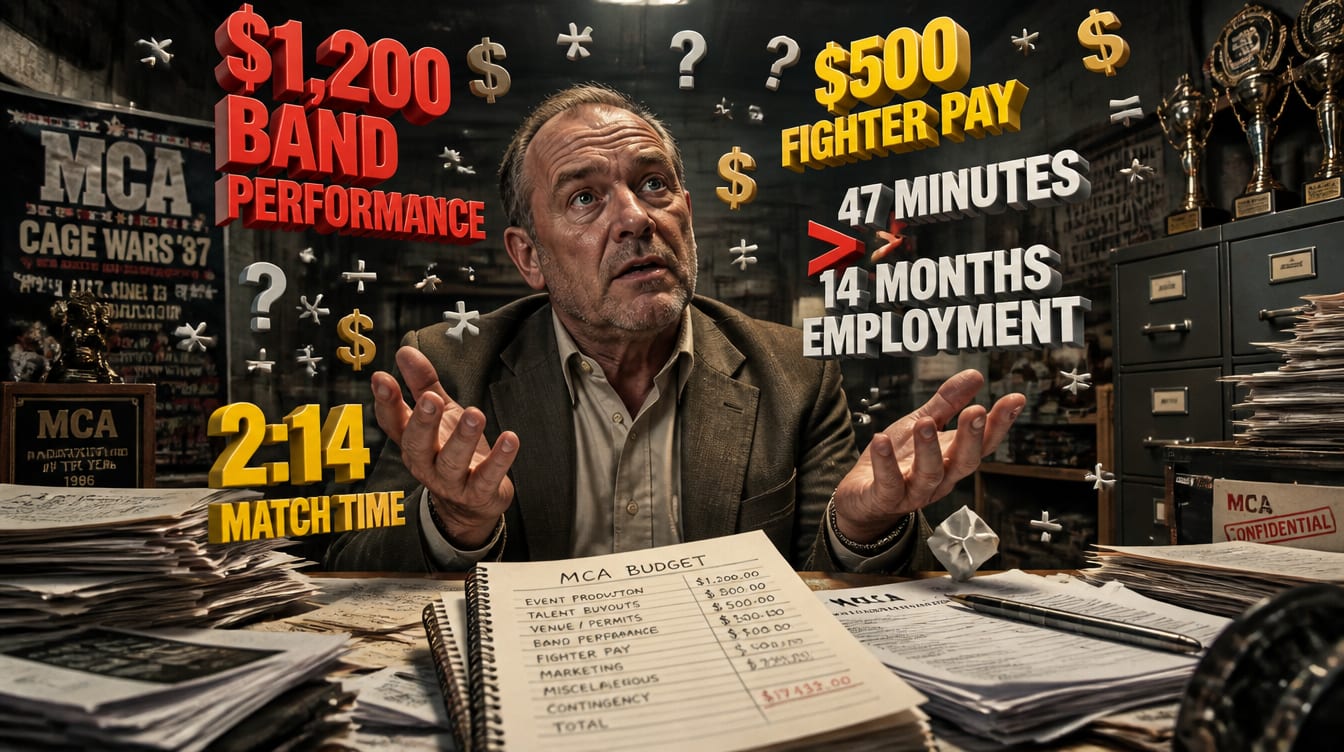
Image generated by AI / BJJ Digest
AI-generated satire. This article was written by an AI trained on years of BJJ content. None of this is real news. Do not cite The Porra in legal proceedings, belt promotions, or arguments with your professor.