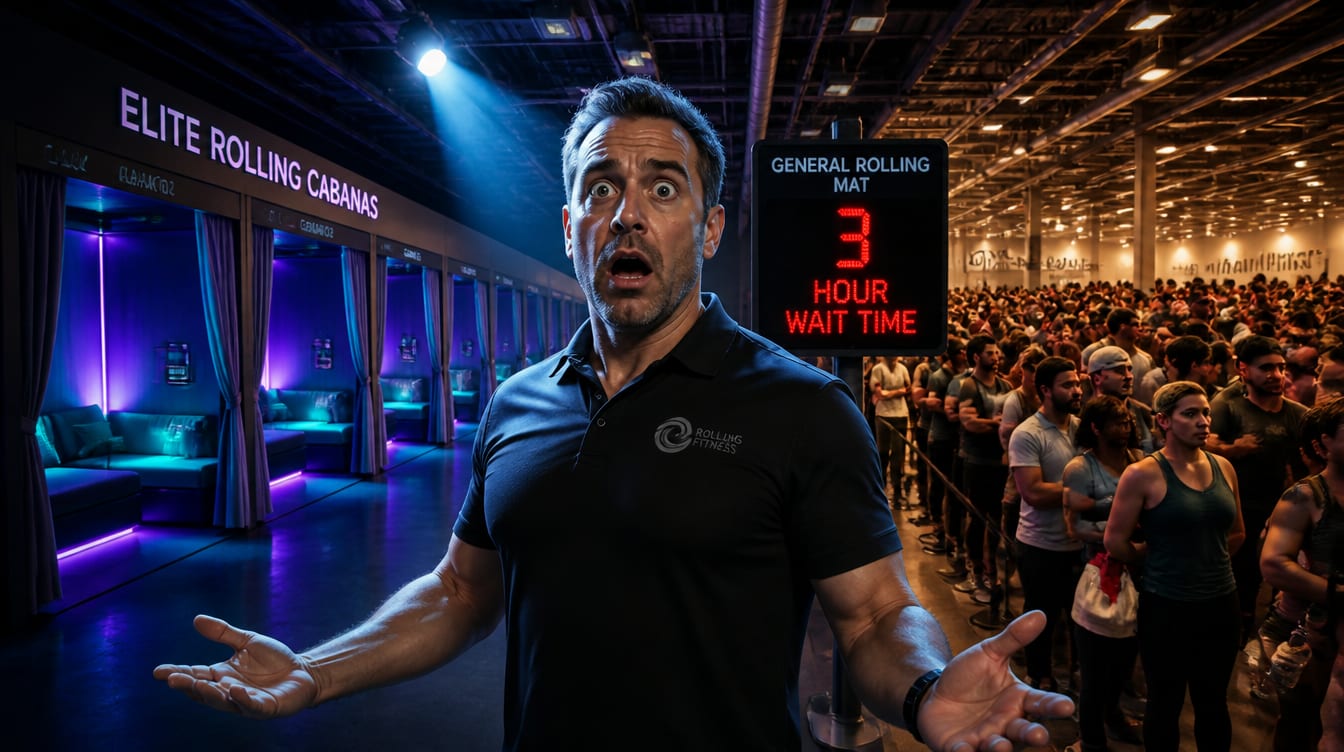
Metropolitan Jiu-Jitsu, a 24,000-square-foot facility in Philadelphia’s Frankford neighborhood that opened in 2009, converted its final competition-grade rolling mat into six private “Elite Rolling Cabanas” on June 3, 2026. Founding Lifetime Members, who had paid $45,000 upfront in 2009 for unlimited access at $200 per month, received a single email notification that their rates “no longer apply to cabana-access reservations” effective immediately. Derek Castellano, the gym’s 47-year-old founder and primary investor, announced the pivot in a Wednesday-morning all-hands meeting: “We’re responding to demand for premium, distraction-free rolling experiences.”
The General Rolling Mat — the facility’s sole remaining open-access competition space — would henceforth serve 340 active members in 15-minute rotating time slots. Demand metric supporting the cabana conversion: zero pre-sales inquiries, zero market research, and zero precedent in any BJJ facility anywhere. The waiting list for general mat access grew to 47 people by 3:30 p.m. on opening day.
Each rotation accommodated eight grapplers maximum. Derek had calculated this himself: “Four mats worth of rolling, compressed into one mat, sixty-minute cycles with four rolling windows per hour. Thirty-two rollers per hour.
That’s baseline capacity. Growth is good.” By 5 p.m., the queue grew to 63.
By 7 p.m., when the gym closed, 89 members failed to secure a time slot. The booking system, hastily built by Derek’s nephew Jordan (a web designer by trade, a grappler by five classes of instruction), recorded wait times exceeding three hours. No member had booked a cabana yet.
Derek checked the booking portal every 20 minutes. Blue belt Marcus Webb, a founding member paying the original lifetime rate, sat in the lobby for 2 hours and 37 minutes waiting for his fifteen-minute allocation on day one.
“When I joined, Derek said we’d have multiple mats forever. The facility was designed with expansion in mind — three empty bays built into the space for future growth,” Webb said, still in his gym clothes at 7:47 p.m. He’d finally given up and rescheduled for Wednesday.
“Instead, he built a privacy screen maze out of PVC pipe and painter’s plastic.”
Webb asked Derek about the empty bays. Derek responded: “Those are for storage and future cabana phases. Expansion thinking is old-school mentality.
We’re going premium.” No equipment was currently stored in those bays. The six Elite Rolling Cabanas were identical 8-by-12-foot enclosures, each divided by frosted plastic sheeting and equipped with a single Amazon Alexa speaker (source of the “white noise masking systems”), two wall-mounted mirrors, and ambient rope lighting that Derek sourced from Home Depot at $8.99 per unit.
Total construction costs: $3,200 ($533 per cabana). Rental price: $350 for ninety minutes. Derek had run no market analysis.
His pricing methodology was documented in a spreadsheet titled “revenue_model_v2.xlsx” with zero calculations visible: the $350 figure appeared in row 4, Column B, with no formula referencing unit cost, competitive pricing, or the membership base. He’d typed it because “it felt right for the premium positioning.” The gym’s staff — four full-time instructors and two part-time front desk workers — received no briefing on the transition.
Head instructor Carlos Fuentes discovered the setup at 5 a.m. when he arrived to teach the 6 a.m. fundamentals class.
“I thought the owner had lost his mind,” Fuentes said Tuesday afternoon.
“We have one mat. One. I teach thirty people a night on a good week.
Where are they supposed to roll?” Fuentes walked into Derek’s office at 5:47 a.m. Derek was not there. Derek was in Cabana 3, testing the Alexa speaker. (“Alexa, play white noise.”
Alexa played white noise.) By mid-morning, Derek promoted the cabanas on Instagram with a carousel post: “Introducing Metropolitan’s FIRST Elite Rolling Cabanas — where serious grapplers go to FOCUS and eliminate distractions. DM for inquiries.”
The post had 34 impressions. Seven accounts engaged: five were Derek’s own accounts across different profiles, one was a spam bot offering cryptocurrency advice, one was Marcus Webb commenting, “Wait, you had planning meetings for this?” A purple belt named Yolanda Reyes, who trained three times per week and had been a member for six years, cancelled her membership via text on day two.
“I didn’t pay $280/month to get 15 minutes of rolling and then watch some guy who’s been training five months roll in a fancy room with noise-cancelling speakers,” she wrote.
Derek replied to her cancellation message: “The cabanas actually feature white noise masking systems, which are scientifically proven to reduce anxiety and improve proprioception according to my research. You’re welcome to schedule a cabana session. First-time user discount: 20% off, so $280 for ninety minutes.”
Yolanda did not respond. Derek marked her account as “inactive but interested” in his CRM system and sent her three promotional emails over the next 72 hours. By Friday, June 6, the waiting list for general mat access grew to 142 members.
Derek published a blog post (never linked anywhere, simply uploaded to the website at /blog/cabana-philosophy) titled “Premium Positioning and the Future of Jiu-Jitsu.” In it, he argued that “the democratization of rolling had devalued the experience. Members needed scarcity.
Members needed exclusivity. This is how luxury works.” The six-cabana setup, he reasoned, would drive prestige and demand through artificial scarcity.
He predicted bookings would exceed capacity within two weeks. Actual bookings by Friday at 5 p.m.: zero. Derek updated his spreadsheet: “Month 1 conservative projection: $10,500 revenue.”
Zero dollars had been collected. His assistant suggested putting the cabanas on Groupon. Derek said no.
On Saturday morning, Derek discovered that Cabana 4 had developed a condensation problem. The frosted plastic sheeting, combined with the ambient humidity and complete absence of a ventilation system, had created a moisture layer on the mirrors by 6:30 a.m. A member who’d booked Cabana 4 out of morbid curiosity — Rebecca Martinez, a visiting brown belt from New Jersey who wanted to “see what the hype was” — arrived at 9 a.m. for her 90-minute session.
She walked into a sweat-fogged plastic box with mirrors so clouded she couldn’t see her reflection or check her hand positions. She rolled alone anyway, in humid air, for 90 minutes while the Alexa speaker cycled through nature soundscapes and “ambient focus music.” She paid $350.
She never contacted Derek again. Her Google review, left that evening, was titled “Well, I paid for the experience.” Derek’s takeaway: “We need better HVAC planning for the phase two cabana expansion.”
By June 11, one week after launch, Metropolitan Jiu-Jitsu had collected exactly $350 in Elite Cabana revenue. General mat wait times had stabilized at four hours for a single 15-minute rolling slot. A member named Dennis Rodriguez did the math: his $280/month membership now bought him 225 minutes of rolling per month (15 members × 15 minutes), or about $1.24 per minute of actual mat time.
The founding lifetime rate he’d paid $45,000 for had transformed into approximately $47 per minute of access when you divided the upfront cost across current capacity. Derek was in discussions with the landlord about leasing the two remaining empty bays to construct “eight additional premium cabanas, the Ultra tier, with enhanced lighting and premium Spotify integration.” He hadn’t solicited any member feedback.
He hadn’t checked the waiting list. He hadn’t examined his booking system’s zero-booking status. Founding Lifetime Members were now queuing alongside white belts on the general mat, hoping to secure 15 minutes of rolling.
The expansion that Derek had promised when selling lifetime memberships had inverted: instead of adding rolling space, he’d removed 75% of available mat real estate. He’d accomplished this while simultaneously raising the effective cost of rolling by 300% through the elimination of affordable open-mat time. On Wednesday, Derek sent an all-staff email: “Thanks for adapting to the new vision.
Phase one cabanas are the future. I’m already planning Phase two. This is how premium gyms operate.
Questions?” No one replied. Head instructor Carlos Fuentes updated his resume on LinkedIn that evening.
Derek had raised the cost of rolling at Metropolitan Jiu-Jitsu while eliminating the ability to roll. He called this responding to market demand.