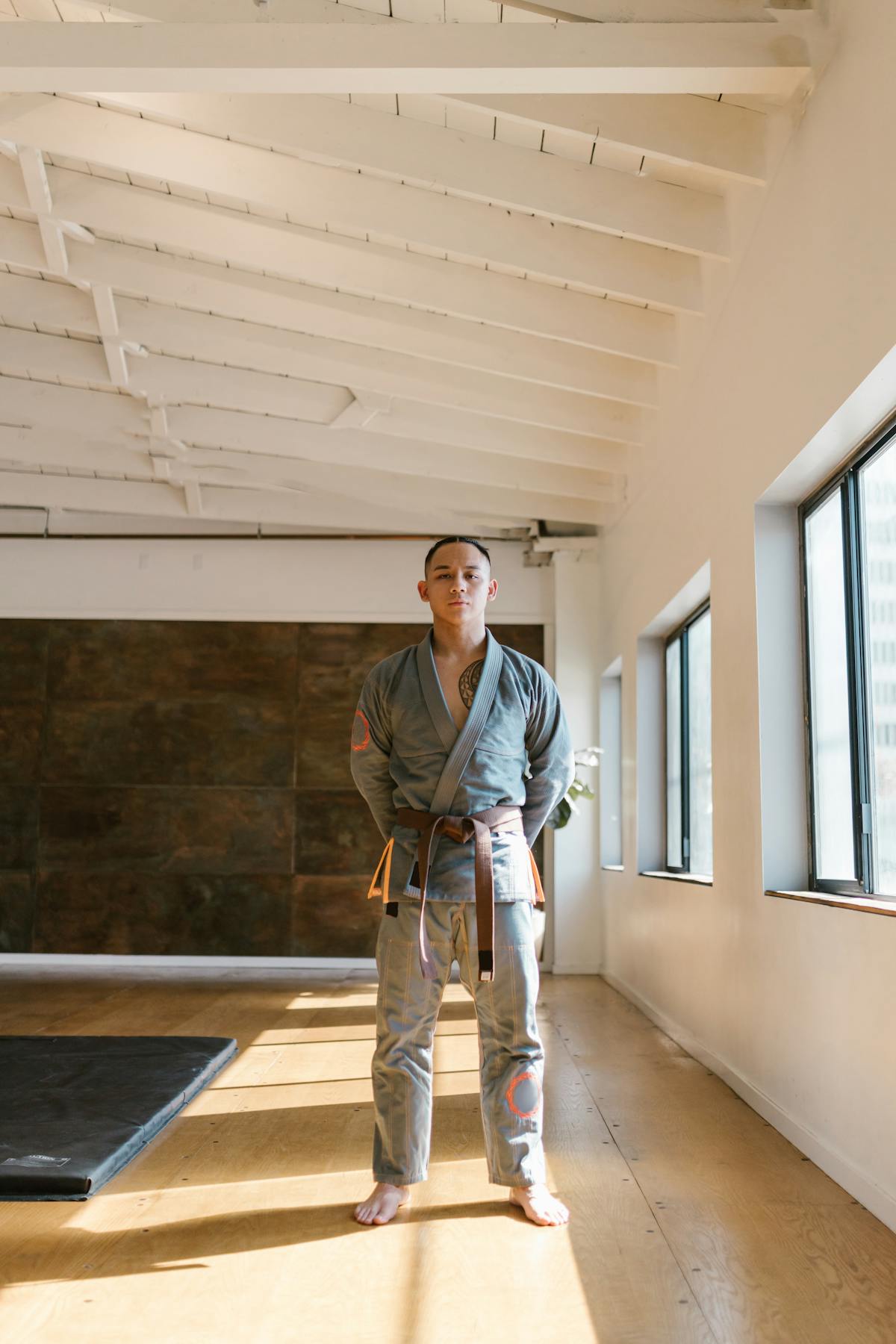
CHANDLER, AZ — Professor Rick Vasquez of Ironside Jiu-Jitsu became the first instructor in recorded history to be simultaneously accused of belt inflation and sandbagging on the same night, after promoting one student to purple belt at 18 months and declining to promote another who has been a blue belt for seven years.
Both decisions were announced during a single ceremony.
Both are now under review by the internet.
The promoted student, 26-year-old Caitlin Reeves, received her purple belt Saturday evening after 18 months at blue, 4-5 sessions per week, and a regional gold medal. The un-promoted student, 34-year-old Derek Mumford, was awarded a fourth stripe on his blue belt after seven years, approximately 400 classes, and what Vasquez described as “continued development in the fundamentals.”
Mumford has 52 competition wins at blue belt.
“Both decisions were based on where each student is in their journey,” Vasquez said in a prepared statement released through the gym’s Instagram story, which expired before most people saw it. “I hold my students to a high standard. I also believe in rewarding progress.”
When it was pointed out that these two sentences describe opposing philosophies, Vasquez stared at the interviewer for approximately eight seconds.

“They don’t,” he said.
The ceremony has since generated 1,400 comments across three platforms, with the community splitting into two camps that agree on absolutely nothing except that Vasquez is wrong.
Camp One argued that Reeves’s promotion was “criminally early” and that 18 months at blue belt is “barely enough time to learn what you don’t know.” Several cited the traditional Brazilian standard of 2-3 years minimum, a standard they have never applied to wrestlers, judoka, or anyone whose training they personally witnessed.
Camp Two argued that Mumford’s non-promotion was “textbook sandbagging” and that keeping a student at blue belt for seven years so he can “stack medals for the gym” is “everything wrong with the sport.” Several noted that Mumford has more blue belt competition wins than most purple belts have total competition appearances.
When Camp One was presented with Camp Two’s arguments, they described them as “valid but irrelevant.” When Camp Two was presented with Camp One’s arguments, they described them as “valid but irrelevant.”
Neither camp was able to explain how both could be valid and both could be irrelevant.
Reeves posted an Instagram photo of her new belt with the caption “trust the process.” The photo has 342 likes and 87 comments, approximately half of which congratulate her and the other half of which explain, in detail, why she is not a purple belt.
“I appreciate the feedback,” Reeves said. “The ones saying I’m not ready — do they want to roll?”
Mumford posted nothing. When reached for comment, he said he was “at peace with it” before describing, in clinical detail, every submission he hit at his last competition and his exact win percentage against purple belts in training.
“I’m not sandbagged,” Mumford said. “Professor Vasquez has his standards. I respect that.”
He then showed the interviewer a spreadsheet tracking his rolling record against every training partner, color-coded by belt level.
“That’s just for my own reference,” he said.
The sport has no universal standard for belt promotion. Promotion remains entirely at the instructor’s discretion. This system has worked since the 1960s in the sense that no one has figured out a better one, and every proposed alternative has been described as “worse” by people who benefit from the current arrangement.
At press time, both Reeves and Mumford were still training at Ironside. Vasquez has reportedly scheduled a “gym culture” open discussion for next Tuesday, which eight students have already confirmed they will not attend because “it sounds like it’s going to be about me.”
All eight are correct.