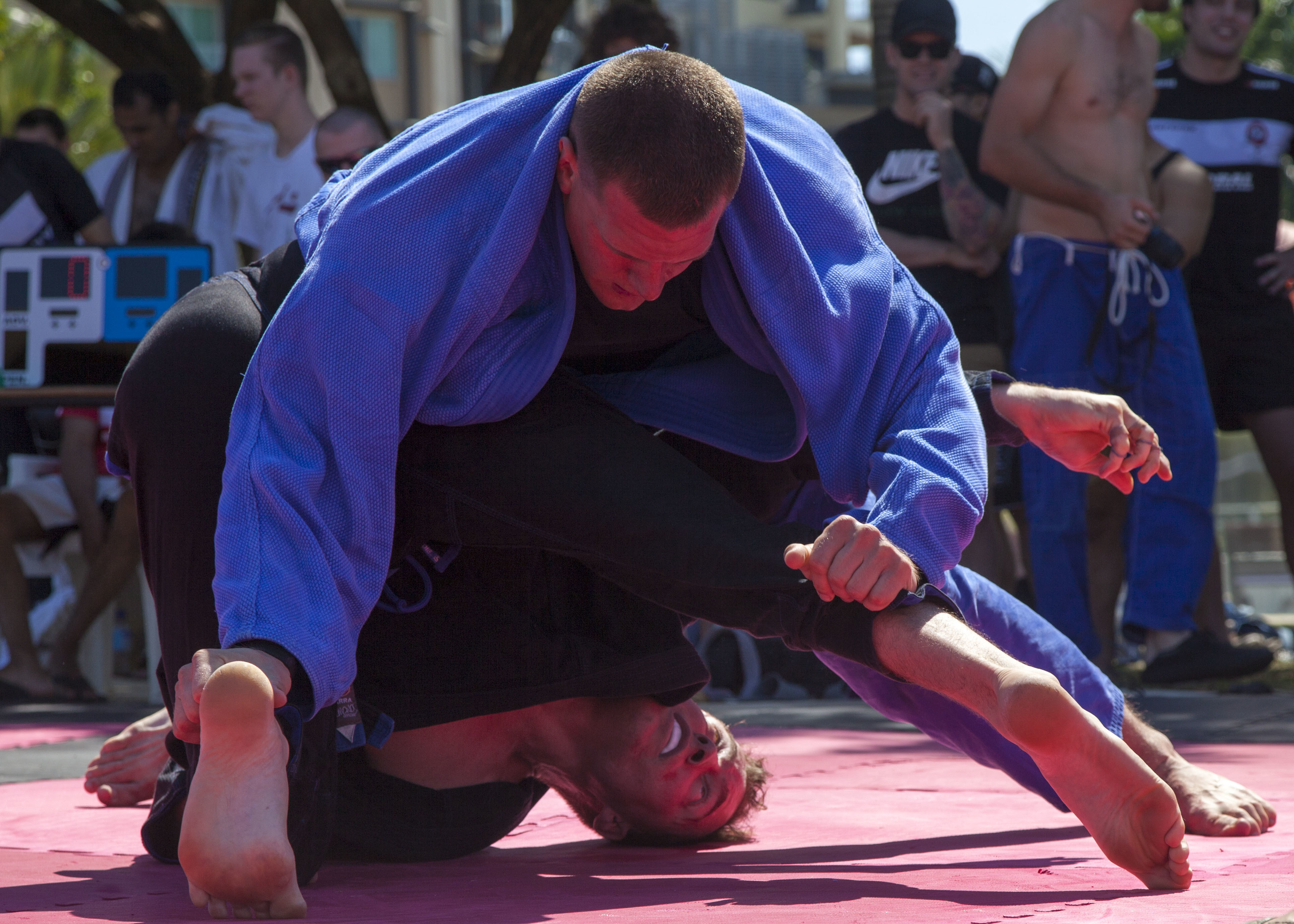
ORLANDO, FL — The International Submission Grappling Association confirmed Tuesday that a 14-month independent audit of its competition scoring system has concluded with what executive director Paul Lazenby called “findings that are both statistically irrefutable and spiritually devastating.”
The audit, conducted by sports analytics firm Kairion Data Group at a cost of $340,000, found that the single highest expected-value defensive action in ISGA-sanctioned competition is not a sprawl, not a frame, not a guard recovery — but simply walking backward until your foot touches the boundary line, triggering a neutral reset to center.
“The numbers don’t lie,” said Dr. Angela Whitford, lead analyst on the report. “A competitor who retreats to the boundary when pressured concedes zero points, resets to a neutral standing position, and restarts the exchange from scratch. Meanwhile, a competitor who attempts an actual defensive technique risks giving up an advantage, a sweep, or a submission. The math says run.”
The 200-page report, titled “Spatial Incentive Structures in Modern Submission Grappling,” found that boundary resets occur an average of 11.4 times per match at the elite level, up from 3.7 per match in 2019. In one memorable case study, the report tracked ISGA’s current #1-ranked middleweight, Derek Colvin of San Diego, and determined he has not engaged another competitor in the center four feet of the mat since November 2024.

“I wouldn’t say I’m running,” Colvin said in a phone interview. “I’d say I’m using every tool the ruleset gives me. If the rules say a reset is free, then a reset is free. That’s not my problem. That’s a them problem.”
It is, apparently, very much a them problem.
ISGA’s rules committee held an emergency session last Thursday to discuss the findings. According to three people present at the meeting, the initial proposal — simply penalizing boundary resets — was rejected after a committee member pointed out that the penalty for a boundary reset under the current framework would still be worth less than the average points conceded during a sustained center-mat exchange.
“We ran the numbers on penalties too,” Whitford confirmed. “Even with a one-point penalty per reset, the EV of retreating still exceeds the EV of engaging by 0.3 points per exchange. You’d need a three-point penalty to break even, and at that point you’re basically awarding a takedown for walking forward.”
The committee’s eventual proposal, which will enter a public comment period in May, is to reduce the competition area by two feet in diameter per year until, in their words, “athletes have nowhere left to run.”
Under the plan, the current 10-meter circle would shrink to 9.4 meters in 2027, 8.8 meters in 2028, and so on, until the competition area is roughly the size of a king-sized mattress by 2034.
“We considered other solutions,” said Lazenby. “Electric fence around the boundary. A moat. Someone suggested a rule where if you touch the line, your opponent gets to slap you. But the graduated shrinkage plan felt the most… institutional.”
Colvin, when informed of the proposal, said he was “not concerned.”
“I’ll just run faster,” he said.