Fieldstone Jiu-Jitsu Academy in Eugene, Oregon announced a ‘commitment to diversity and inclusion’ on June 10, 2026, by stocking exactly one female-specific gi size in their pro shop: A0 (extra small). The announcement came via email to all 247 registered members, accompanied by a press release featuring a stock photo of an unidentified woman mid-armbar and language carefully crafted about ‘creating space for underrepresented voices in the grappling community.’ When asked by a student how many A0 gis were in stock, owner Marcus Feldman said “several,” then later clarified as “three, maybe four before someone buys one.” The gis were priced at $89 retail. Feldman sourced them from a distributor that carried sizes A0 through A4 in women’s-cut gis, but investing in inventory across the full range seemed inefficient for a single location. “We’re supporting diversity by having women’s gear available,” Feldman explained in response to student inquiries. “If you need other sizes, we can absolutely special order them from the distributor for you.” The special order process involved a 6-week lead time, a 25 percent markup ($20 more than in-stock pricing), and filling out a custom order form that Feldman claimed he had to personally “coordinate with the distributor’s warehouse system.” Three female blue belts requested A1 sizes in the first week after the announcement. Two received the special order form. One read the cost and the timeline, thought about the $109 price tag, and never followed up. The decision cost Feldman nothing upstream. Inventory carrying costs for 3-4 A0 gis in a 2,400-square-foot academy on a shoestring budget: negligible. The appearance of inclusion, the press coverage, the sense that Fieldstone was progressive and forward-thinking? Priceless. The actual inclusion—carrying A0 through A2 in multiple colors, designing cuts that honored different body types, or even hiring a female student consultant to advise on what was actually needed—would have required working capital investment and valuable shelf space. The press release was cheaper. Feldman hired a freelancer on Fiverr to write it for $150. It took forty minutes. The press release was shared 89 times on Facebook by people who did not train at the gym. “We wanted to send a message that Fieldstone is a place for everyone,” the press release read. The message, apparently, was “Everyone who is extra small and willing to pay a premium and wait six weeks.” The stock photo showed a woman in a gi that fit correctly, with proper sleeve length and appropriate shoulder width. None of the A0 gis in Fieldstone’s pro shop fit correctly. One was slightly too wide in the shoulders, creating a sail effect during armbar escapes. One had armholes that rode up to mid-bicep, cutting off circulation to anyone bigger than 5’2”. The third one—the “maybe four”—hadn’t arrived yet. Feldman had stopped answering emails about lead times. By June 15, exactly one A0 gi had sold, to an 18-year-old white belt named Keisha who was, in fact, extra small and willing to roll in suboptimal equipment because nothing else was available. She wore it to class, the shoulders gaped noticeably, and she rolled with it anyway because the alternative was wearing the men’s A0 that hung like a poncho. Feldman saw her in class, took a photo mid-armbar for Fieldstone’s Instagram, tagged it “#DiversityMatters #InclusiveGrappling,” and got 7 likes. Five were from Keisha’s high school friends. Two were from other gyms that didn’t know the context. On June 12, a 25-year-old purple belt named Sarah texted Feldman to ask if he’d consider stocking women’s sizes regularly—not as a special order system with markups and lead times. Sarah had been a loyal member at Fieldstone for three years. She’d been buying men’s A1 gis and taking them to local tailors at $45 a pop because nothing in the pro shop came close to fitting. “It would be one of the only gyms in the entire Eugene metro area that actually did this,” she wrote. Feldman responded: “We’re limited by distributor availability right now.” The distributor carried every size. He’d never called them. The press release had gotten tons of engagement on Fieldstone’s Facebook page, mostly from fitness enthusiasts and local business commentators who appreciated the ‘inclusive messaging’ without understanding what it actually meant. Actual women at the gym had shared it with comments like “One size lol” and “Cool initiative, I guess.” One comment, from a white belt named Jessica, asked where in the pro shop the women’s section actually was. Feldman deleted the comment, then felt guilty, reinstated it after noticing Jessica in class that night, felt awkward, and ultimately blocked her on Instagram anyway. Other gyms in the Eugene area noticed Fieldstone’s initiative. Alliance Grappling, 8 miles away, quietly added two A1 women’s gis to their regular inventory and said nothing about it on social media. Zenith Martial Arts, 12 miles away, ran a survey asking all female students what sizes and cuts they actually needed, ordered accordingly, and posted the full size chart on their website—without a press release or announcement. Fieldstone’s announcement got exponentially more engagement. Their ‘diversity initiative’ was celebrated in a local business and wellness blog. Zenith’s actual diversity investment generated zero press mentions and zero engagement metrics. By mid-June, Feldman was considering his next inclusion-focused announcement. He’d heard that some progressive gyms were adding “gender-neutral” locker room hours. The policy would cost nothing to implement. The optics would be solid. He drafted an email to all members. He didn’t mention that his locker room already had individual changing stalls with privacy locks—meaning the policy was already functionally gender-neutral. But announcing it would loudly demonstrate commitment to inclusion without requiring any actual structural change. The announcement was cheaper than solving real problems. The message was all that mattered. When Sarah came in for Tuesday evening class and saw the “Gender-Neutral Locker Room Hours (Effective June 18)” announcement posted on the bulletin board above the lost-and-found, she asked Feldman when they started. “Next Monday,” he said. Sarah asked if anything was actually changing about the physical facilities or the access. “The facilities will be available for everyone during those hours,” Feldman said, which was technically already true all day. She nodded, accepted the non-answer, and focused on her rolling instead. The gym had diversity now. Everyone could feel good about it. The A0 gi hung in the pro shop, still slightly too loose in the shoulders, waiting for the next extra-small student to arrive with limited options and no complaints.
Local Gym's 'Diversity' Win: One Female Gi Size
Fieldstone Jiu-Jitsu declared diversity victory by stocking one female gi size. Read how one academy defines 'inclusion' in jiu-jitsu.
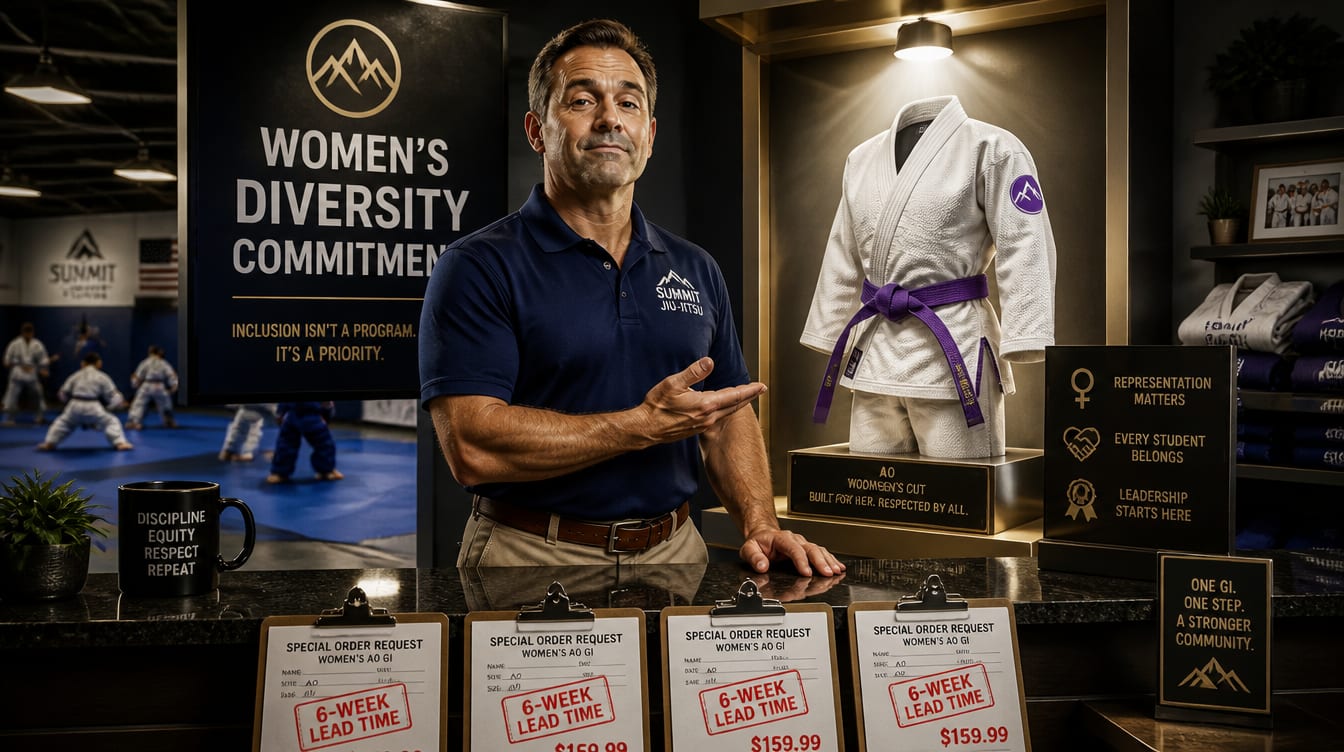
Image generated by AI / BJJ Digest
AI-generated satire. This article was written by an AI trained on years of BJJ content. None of this is real news. Do not cite The Porra in legal proceedings, belt promotions, or arguments with your professor.