Marcus Chen, 32, a brown belt at Prestige Grappling in Tempe, Arizona, published a 2,400-word manifesto on Instagram Wednesday morning titled “The Chen Protocol: Proprioceptive Load Management Through Micro-Rep Sequencing.” The system, which he began marketing to students at $1,200 per month for a six-week package (six 30-minute sessions), is performing three jiu-jitsu techniques—a mounted armbar, an armdrag-to-back transition, and a basic knee-slice guard pass—at half speed. That’s it. No progressive loading. No tempo variation. No periodization. Just slow. Within three days, eleven students had signed up. By Friday, Marcus had created a 47-slide PowerPoint presentation (available for an additional $300) with diagrams of the three sequences, color-coded by “neural pathway activation zones.” The zones were not labeled. Coach Derek Timmons, who owns Prestige Grappling and has been teaching jiu-jitsu for fifteen years, learned about the protocol during open mat on Thursday. “Look, I’ve seen people charge for a lot of dumb things,” Timmons said while watching Marcus coach a student to perform an armbar in seven seconds instead of three. “The weird part isn’t that someone’s doing this. The weird part is that people are paying for it. That’s actually not the worst thing I’ve seen someone charge for. I’ve got a purple belt in the back who tried to sell ‘oxygen debt training’ by just having people run stairs with duct tape on their mouths.” Marcus’s pitch to students emphasized the neurological science of slow repetition. His Instagram post cited “peer-reviewed research on motor learning” without links, the journal names spelled phonetically (“The Journal of Neurological Sport-Specificity”), and a quote from an unnamed “biomechanics consultant in Sweden” who Marcus described as “probably the best in the world, honestly.” When a blue belt asked for sources, Marcus replied: “The data is proprietary. I shared it with some coaches at a gym in Florida. They all bought in immediately.” No gym in Florida, when contacted via email, had any record of Marcus or his protocol. The techniques Marcus selected for the protocol are the exact movements taught on day one of fundamentals class at Prestige Grappling. Students learn them in twenty minutes. Marcus’s version involves ten minutes of explanation about “load distribution” before the drill begins, followed by five minutes of feedback on whether they’re going “slow enough.” Most feedback: “Slower. Slower. No, slower. You’re still thinking in normal-time terms.” By week two, Marcus had expanded the protocol to include a 40-page PDF (“The Proprioceptive Manifesto,” $200 separate purchase) that explained why traditional jiu-jitsu instruction had been “neurologically illiterate” for decades. The paper’s central argument: slow movement teaches the nervous system more than fast movement. His evidence: “Trust me, bro. My nervous system has never been sharper.” Three students asked if they could just attend regular fundamentals instead. Marcus offered a discount on their remaining sessions ($300 instead of $400 per month), claiming the discount “validated their neural investment so far.” All three kept paying. Derek Timmons watched the protocol gain traction and decided to lean into it. He announced his own “anti-protocol” offering: $800 per month for eight sessions called “The Timmons Principles,” which is exactly the normal class except Derek has students perform techniques at 150% speed instead. He called it “acute neurological overload training” and cited research from “probably Sweden.” First week, six students signed up. One asked if this was a parody. “It might be,” Timmons said. “I honestly can’t tell anymore.” By week four, Marcus had pivoted. The next phase of his protocol, released via a private Instagram Story (reposted by a student to the gym’s group chat), involved not just drilling slowly, but drilling slowly while thinking about “proprioceptive intention.” This meant the student had to talk through what their body was “sensing” during each repetition. An armbar took four minutes. A guard pass took eight. An armdrag-to-back transition took until the end of class. One student, a lawyer named Brian Westcott, paid attention to the detailed invoice Marcus had sent. It broke down his $1,200 fee as follows: —Protocol access: $400 —Neurological consultation (a single text message per week asking how the student felt): $300 —Data analysis (Marcus recording videos of the student and not watching them until asked): $250 —Proprioceptive certification exam (test scheduled for week 7, content TBD): $250 Westcott asked Marcus, point-blank, if this was different from the fundamentals class he could take twice a week for $150 per month. Marcus thought for twelve seconds. “The difference,” he said, “is intention. Fundamentals is about doing the technique. The protocol is about understanding the technique.” When Westcott noted that the fundamentals instruction explicitly teaches understanding through repetition and breakdown, Marcus smiled. “Yeah, but slower.” The proprioceptive certification exam, when it arrived in week six, consisted of a single question: “What does proprioceptive mean?” (Acceptable answers: “awareness of the body in space,” “body sense,” “knowing where you are,” or “slow jiu-jitsu.”) All eleven students passed. By week seven, Marcus announced a Level 2 protocol for advanced practitioners ($1,800 per month, eight sessions). The curriculum: the same three techniques, now performed at 40% speed, with the addition of “intentional breathing patterns” (inhale for four seconds, exhale for four seconds, that’s it). Timmons, watching this unfold, decided to create a Level 2 anti-protocol: $2,200 per month for “advanced acceleration training,” which is the normal curriculum taught at double-speed in a room with energetic music. First student: Derek’s teenage son, who said it was “probably a scam but at least it’s funny.” Son completed it. Son still doesn’t know jiu-jitsu any better. Marcus Chen, six weeks in, had generated $16,800 in protocol revenue and was already planning a franchise model: “Certified Protocol Coaches” for gyms nationwide. The only requirement, he explained to Derek, was that they purchase the $2,000 certification package, attend two Zoom calls, and commit to “the philosophy.” Derek asked him to define the philosophy. Marcus replied: “Slow down. That’s it. That’s the whole thing. Tell them the nervous system needs time to adapt. Charge based on how much slower you want them to go.” Derek, surprisingly, didn’t kick him out. “You know what?” he said. “At least he’s consistent. He’s selling people what he said he was selling. They’re paying for slow reps and getting slow reps. It’s the most honest thing I’ve seen a brown belt do all year.”
Brown Belt Markets $1,200 Slow Drilling 'Protocol'
Marcus Chen charges $1,200 monthly for slow drilling repackaged as 'scientific protocol.' His gym owner's counter proves the entire premise is ridiculous.
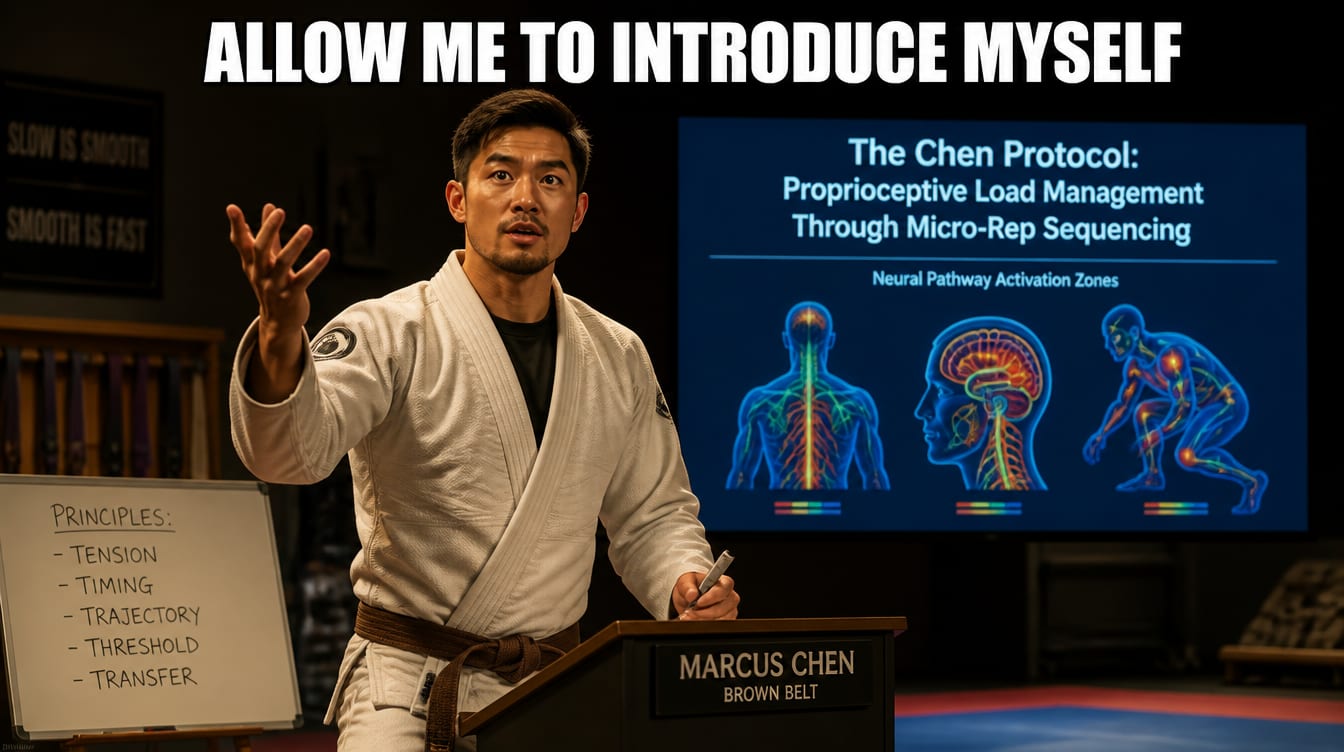
Image generated by AI / BJJ Digest
AI-generated satire. This article was written by an AI trained on years of BJJ content. None of this is real news. Do not cite The Porra in legal proceedings, belt promotions, or arguments with your professor.