Marcus Reeves, a 34-year-old brown belt at Ironside Jiu-Jitsu in suburban Atlanta, arrived at Wednesday evening open mat exactly 48 hours after undergoing arthroscopic knee surgery. His orthopedic surgeon, Dr. Patricia Chen, had provided a written post-operative instruction sheet that stated, in clinical terms: “Patient to observe gym activities only. No participation in grappling. Six-week restriction minimum.” By 7:43 p.m. — 22 minutes after walking through the door — Reeves had borrowed a gi from the lost-and-found, borrowed tape from the athletic trainer’s stock, and executed a flying armbar from seated position against a now-traumatized blue belt named Derek. The orthopedic detail that made this worse: the hinged knee brace Reeves wore throughout the entire twenty-two-minute rolling session was on his right leg. The surgery was on his left knee. The brace — a $340 carbon-fiber stabilizer with hinged support, purchased that morning — had been fastened to the wrong limb entirely. When Coach Marcus pointed this out between rounds, Reeves nodded, said “I know,” and didn’t swap it. He finished the session still wearing orthopedic protection for the wrong joint while the actual surgical site remained unsupported and, in the words of the blue belt, “definitely more purple than before we started.” Coach Marcus (no relation), who has overseen Ironside for seven years, confirmed the broader pattern without apparent surprise. “This is his third medical violation this year,” Marcus said, scrolling through the gym’s WhatsApp chat to find evidence. “February, he showed up two days post-shoulder surgery with his arm in a sling and rolled collar chokes anyway. Kept saying the sling wasn’t part of the surgery, just the doctor being ‘cautious.’ March, ribs. He had imaging results that day. Showed up to open mat, did mount escape drills, ate a burrito afterward like nothing happened. I’ve started keeping screenshots of doctor’s notes.” The blue belt, Derek Paulson, a 26-year-old accountant, had agreed to a light flow roll with Reeves because he didn’t know about the surgery. By six minutes in, Reeves initiated a closed guard, did an underhook escape into a high-elbow grip, and launched himself — both feet off the mat, full hip extension, surgical knee brace pointing at Derek’s eye — into a flying armbar. Derek tapped. Reeves landed hard on his right hip, got up, said “good one,” and immediately began watching the next round of rolling. His gi was borrowed. His tape job was uneven. His knee brace was, again, on the wrong leg. Dr. Chen, when reached for comment about Reeves’ post-operative behavior, didn’t express surprise either. She said she’d recently updated her post-surgery instruction template to address “a specific demographic of patient” who she now addresses directly. “I’ve started writing discharge instructions in the second-person plural,” she said. “Not ‘you should avoid grappling.’ Now it’s ‘you and your teammates should avoid grappling,’ and I include examples of positions that might tempt you to roll despite surgical restrictions.” She was asked if this was specifically because of Reeves. She didn’t say no. Ironside’s insurance broker, Janet Weatherby, has since requested a written policy on “athlete-initiated medical violations” after Reeves’ three incidents in four months triggered a routine liability review. The gym’s policy currently states that members must inform coaches of injuries before rolling. It doesn’t account for members who inform coaches, provide written medical documentation, and then violate it within twenty-two minutes. Weatherby suggested language: “Members who ignore post-operative restrictions do so at their own liability and waive the gym from coverage.” Coach Marcus asked if this would make the gym legally liable if Reeves re-injured himself while ignoring a doctor’s note. Weatherby said yes, and then asked if Reeves was going to keep doing this. The February shoulder incident had been minor. Reeves’ rotator cuff got an MRI, and the radiologist saw minor inflammation, nothing surgical. The surgeon cleared him for “light activity” in two weeks. Reeves interpreted this as “I can roll tonight if I don’t go too hard,” showed up day-two post-clearance in a sling, rolled defensive collar chokes for forty minutes, and then reported to the team group chat: “shoulder feels great btw.” The group chat did not agree. Teammate Carlos texted: “dude your arm is hanging like a broken puppet.” Reeves: “it’s supposed to do that.” (It wasn’t.) When asked why he ignored the post-surgery restriction, Reeves said it was important to “stay connected to the team” and that sitting out for six weeks would mean “losing his position in the rolling order.” He seemed genuinely convinced that mat time within two days of surgery was a reasonable tradeoff for not “falling behind.” He added that he’d brought the doctor’s note to be responsible, not as a guide. When asked what responsibility meant in that context, he didn’t answer directly but said that the flying armbar “actually felt good” and he was “feeling optimistic about recovery.” The team’s reaction has been mixed. Veteran black belt instructor David said, “We’ve tried telling him no. He just waits until we’re busy with other rounds and slips into a flow session.” Younger white belts have started warning new rolling partners in the five minutes before their matches with Reeves: “He’s probably recovering from something. Just be aware.” One new student asked if there was a medical waiver he needed to sign before rolling with Reeves. There isn’t. There is now a Slack channel called #marcus-recovery where the team posts updates on his various restrictions and violations. It has eighteen messages. Fifteen are screenshots of doctor’s notes. Three are photos of the wrong-leg knee brace. Dr. Chen’s revised discharge instructions, due to be implemented at her practice next month, now include a specific paragraph on martial arts practitioners: “If you are a brown belt or above in any grappling art, the following six-week restriction is for everyone you train with, not just yourself. Your training partners didn’t consent to be your post-operative rehabilitation partners.” She mentioned she’d already printed 150 copies. When asked if this was overkill for a single patient, she said: “I have a feeling I’m going to see a lot more Marcus Reeveses. This seems efficient.”
Brown Belt Rolls Armbar 22 Minutes Post-Surgery
Brown belt Marcus Reeves returned to open mat 48 hours after knee surgery and immediately executed a flying armbar, defying his surgeon's orders.
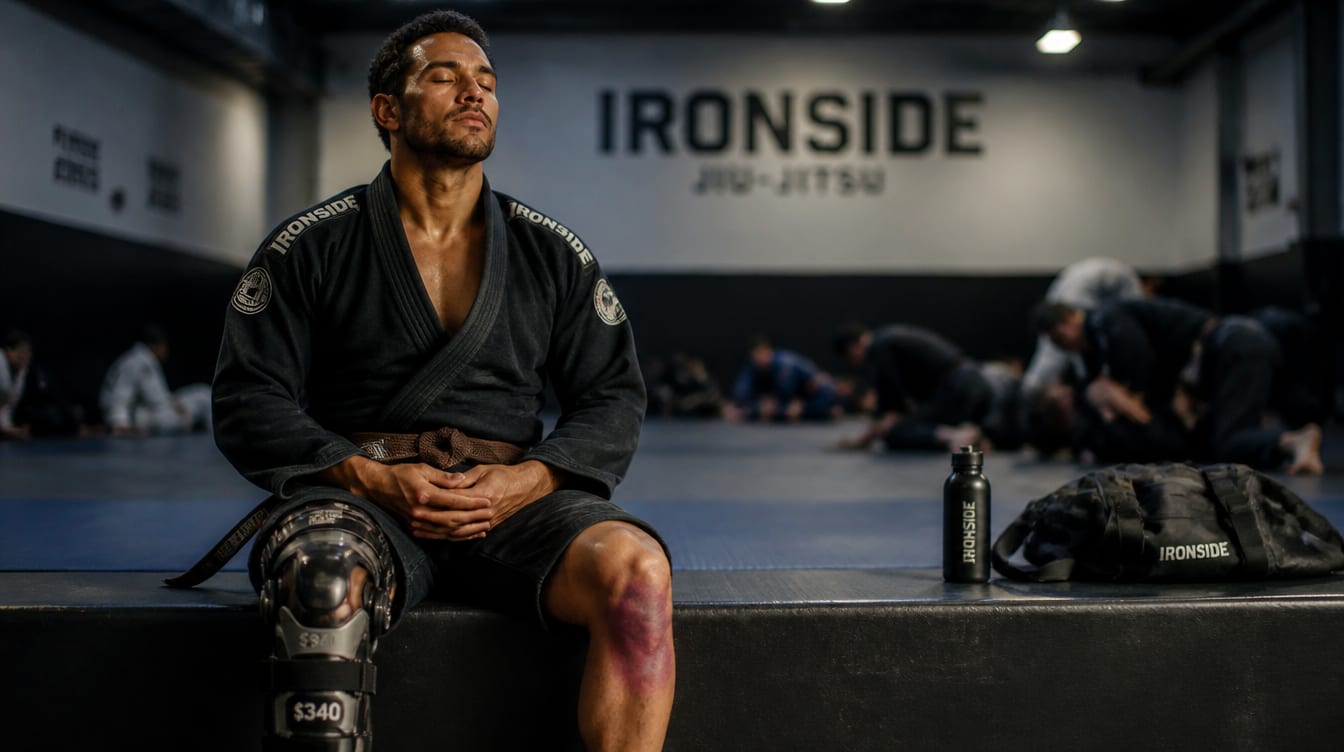
Image generated by AI / BJJ Digest
AI-generated satire. This article was written by an AI trained on years of BJJ content. None of this is real news. Do not cite The Porra in legal proceedings, belt promotions, or arguments with your professor.