Marcus Torres, a 31-year-old two-stripe blue belt at Westside Grappling in Phoenix, announced this week that he’s launching a Competition Coaching Circle to help white belts prepare for their first tournaments. His qualifications, according to a 47-line Instagram carousel posted Tuesday: “I have watched 47 competitions and analyzed every positioning mistake. I have identified the top three takedown defenses across 200+ hours of match footage. I understand the mental game.” His actual match experience: zero tournament entries across eight years of training. Torres began rolling at Westside in 2018, the same year he started a spreadsheet titled “Competition Data Analysis v1.” The spreadsheet has 47 rows—one for each tournament he has watched. Columns include: tournament name, date watched, number of matches observed, and a notes section filled with observations like “everyone’s heel hook game weak at blue level” and “arm drag to body lock appears in 34% of top matches.” Torres has never attempted a heel hook against a resisting opponent. He has watched others attempt them on YouTube. The first session of the Competition Coaching Circle was scheduled for Thursday evening at 7 p.m., with an initial cohort of five white belts. The curriculum, according to a Google Doc shared with students, consists of six weeks covering: takedown defense (Week 1), mental resilience (Week 2), scoring strategy (Week 3), referee psychology (Week 4), and what Torres calls “advanced positioning theory” (Weeks 5–6). When asked during the first meeting how he would teach takedown defense, Torres pulled up a YouTube video of a Rafael Formiga instructional from 2019, played it at 0.75x speed, and said, “Pay attention to his hip positioning.” The video was 34 minutes long. The session lasted 47 minutes. One of the students, a 24-year-old named Derek Hollis who has trained for 14 weeks, asked during a break: “How did your first competition go?” There was a pause. Torres looked at his notes. He looked at his spreadsheet. He said, “Mine’s coming soon, definitely. I’ve been training for eight years. I’m just really selective about which tournaments I enter.” He then pivoted to asking Derek which competitions he was considering and immediately opened his laptop to “analyze them against my dataset.” Derek’s tournament of choice was a local white belt division with 23 entries. Torres spent 12 minutes showing Derek that “most competitors at your level are probably weak on leg lock escapes” and recommended he watch a 45-minute Gordon Ryan instructional. Derek asked if Torres had competed against people who used leg locks. Torres said, “Not directly, no. But I’ve observed the patterns.” The second student, a 19-year-old named Alexis Chen training for 8 weeks, asked if Torres had any advice for staying calm during her first match. Torres opened his phone and read aloud from a Medium article titled “Competition Anxiety in Combat Sports” that he had screenshotted two weeks prior. The article was written by a sports psychologist who had never trained jiu-jitsu. When Alexis asked if this advice came from Torres’s own competition experience, he said, “The theory applies universally. I’ve absorbed a lot of competitive knowledge over eight years of dedicated observation.” She nodded and said nothing. He’s got excellent technique for a blue belt. His arm drag is sharp. His positional control is tight. He’s got zero interest in competing. When asked by gym owner Patricia Sanchez why he decided to start coaching competition prep, Torres said he noticed “an opening for analytical coaching.” Sanchez asked if he had ever tested his advice in a tournament. Torres said, “Not yet, but I’m planning to enter something in Q3.” It’s the fifth time in three years that Torres has mentioned entering a tournament in an upcoming quarter. The tournaments in Q3 2026 (July–September) number 31 registered events within 100 miles of Phoenix. Marcus has told five different people that his “upcoming competition” is happening next month. To Derek, it’s “late July.” To Alexis, it’s “probably August, just waiting for the right bracket.” To another student, Ryan, it’s “whenever I finish my competition prep—I’m basically designing my own training camp.” Ryan pointed out that this meant Torres was coaching a competition circle while simultaneously preparing for his own first competition. Torres said, “Yeah, that’s the beauty of it. We grow together.” Ryan has not returned to the second session. The Competition Coaching Circle’s third session covered “scoring strategy,” during which Torres walked through the IBJJF ruleset (which he has read twice, both times online) and showed five different YouTube clips of matches where points were controversial. He said, “See, the ref made a mistake here.” All five clips showed refs making different calls in different situations. When asked how to avoid referee judgment, one student asked if Torres had any experience with disputed calls in his own matches. Torres said, “That’s not really relevant since I haven’t competed.” He then spent 18 minutes explaining how the refereeing bias toward footlock attacks is actually a strategic advantage if you frame it correctly. He has never attacked a footlock. Westside Grappling’s owner Patricia Sanchez hasn’t shut down the program, mainly because Torres isn’t charging the white belts. He’s doing this as a free weekly service. When she asked if he felt comfortable teaching concepts he hadn’t stress-tested in competition, Torres said, “Knowledge doesn’t have to be practical to be useful. I’m offering strategic frameworks.” Sanchez offered to connect Torres with one of the gym’s competing brown belts who might co-coach. Torres declined, saying, “I think it’s better to keep the methodology pure.” By “pure,” he means untainted by anyone who has actually entered a tournament. As of Thursday, the Competition Coaching Circle has 5 confirmed attendees for week four. Four are considering taking a break. Marcus is already planning an expansion module on mental visualization for week seven.
Blue Belt Launches Coaching Circle Despite Zero Competitions
A two-stripe blue belt with zero tournament entries launches competition coaching after watching 47 YouTube matches. Gym culture, amplified.
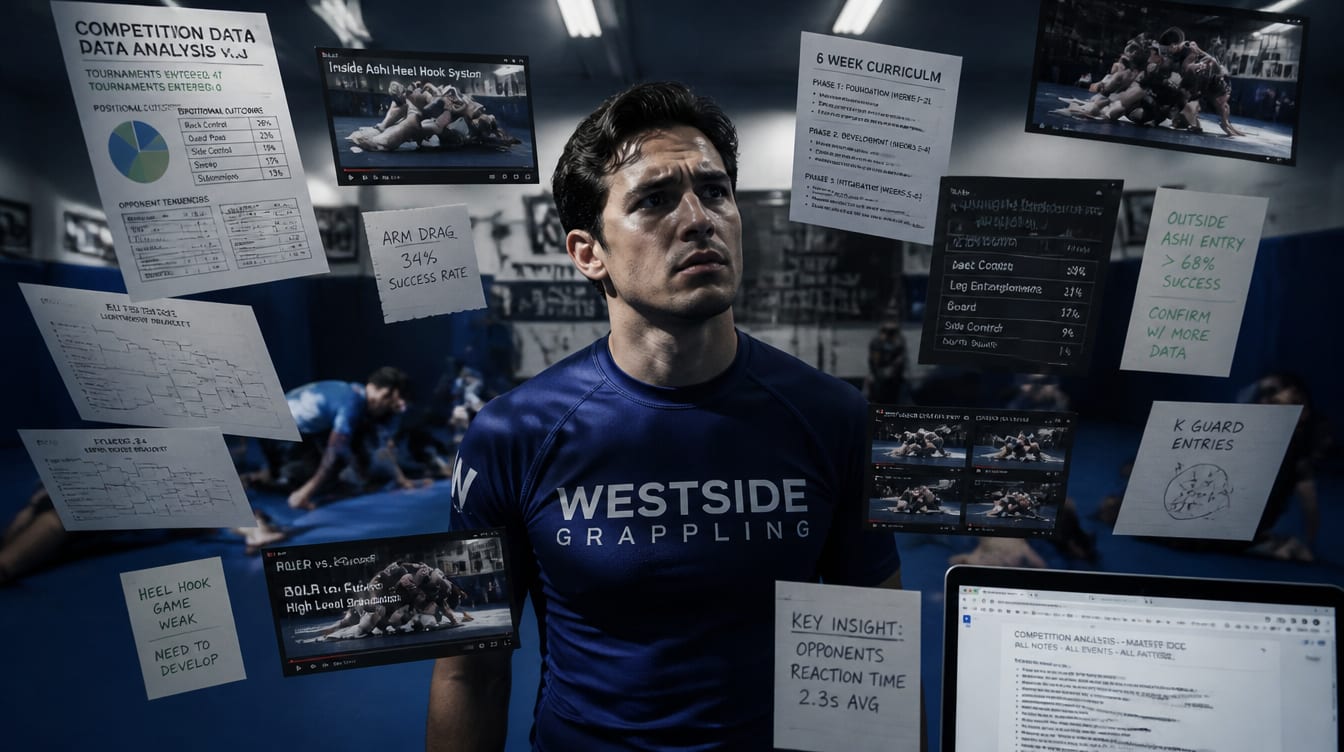
Image generated by AI / BJJ Digest
AI-generated satire. This article was written by an AI trained on years of BJJ content. None of this is real news. Do not cite The Porra in legal proceedings, belt promotions, or arguments with your professor.